The Man Who Drew the Future
Frank R. Paul painted every Amazing Stories cover from 1926 to 1929. He invented the visual vocabulary of science fiction. He was the only guest of honor at the first World Science Fiction Convention — not a writer, not an editor, the artist. He also illustrated the story on page 451 of the August 1927 issue. That part tends not to come up.
The Invisible Man
In 1939, the first World Science Fiction Convention was held in New York. The organizers chose one person to be the guest of honor. Not H.G. Wells, who was still alive and had shaped the field more than anyone. Not Hugo Gernsback, who had invented the magazine category. Not any of the writers whose names filled the tables of contents of every pulp on the rack.
They chose Frank R. Paul. The cover artist.
The people in that room — the first organized community of science fiction readers ever assembled — understood something about Paul that has since been largely forgotten: that the covers were not decoration. They were the argument. Before you read a word of any story in Amazing Stories, Frank R. Paul had already told you what the future looked like. He had been doing it, month after month, since April 1926. By 1939 he had painted that future several hundred times.
The readers knew. The historians mostly missed it. Paul spent the rest of the twentieth century as a footnote — the guy who drew the covers — while the writers he illustrated became canonical. That inversion is worth examining. So is the specific issue he painted in August 1927.
Frank Rudolph Paul, 1884–1963
Born April 18, 1884, Radkersburg, Austria-Hungary. Studied art in Vienna, Paris, and New York. Trained as an architect. Emigrated to the United States in 1906. Hired by Hugo Gernsback in 1914 to illustrate The Electrical Experimenter. Painted 38 covers for Amazing Stories from April 1926 to June 1929. Painted 103 covers for the Wonder Stories magazines from June 1929 to April 1936. Painted the cover of Marvel Comics #1, October 1939 — the first appearances of the Human Torch and Sub-Mariner. Inducted into the Science Fiction Hall of Fame, 2009. Died June 29, 1963.
What He Built
Before Frank R. Paul, there was no agreed-upon image of the future. Rockets did not look like rockets. Aliens did not look like aliens. Space stations, ray guns, robots, extraterrestrial landscapes — none of these had visual conventions, because the genre that would require those conventions did not yet exist as a distinct category.
Paul invented most of them.
He worked, by his own account, from 10 in the morning until midnight, seven days a week. He rarely read the stories he illustrated — he worked from editorial summaries, or from nothing, filling in the gaps with his own sense of what a thing ought to look like. He painted in primary colors, partly by preference and partly by necessity: the pulp printing process of the 1920s could not reliably reproduce subtle gradations. His figures were notoriously stiff. His machines were not. The machines were extraordinary — detailed, original, technically coherent. “He never drew the same spaceship twice,” one historian noted, “and he drew hundreds.”
In August 1929, Paul painted the first color image of a space station ever published in the United States, for the cover of Science Wonder Stories. In November 1929, he painted what is considered the earliest depiction of a flying saucer — a disc-shaped craft hovering over a landscape — nearly two decades before Kenneth Arnold’s 1947 sightings made the image culturally ubiquitous. It has been speculated, not entirely as a joke, that Paul accidentally created the UFO craze by establishing the visual template so thoroughly that witnesses in 1947 and after reached for the shape he had already put in their heads.
Arthur C. Clarke, writing in the introduction to a Paul retrospective, described how he first encountered science fiction through a 1928 issue of Amazing Stories with a Paul cover depicting Jupiter. Clarke noted that Paul had painted the planet’s cloud formations — turbulent, cyclonic, marked with enormous white structures — with what Clarke called “stunning accuracy.” Those formations were not confirmed by observation until the Voyager missions, fifty years later. Clarke’s question was sincere: “How did he know?”
The answer is probably that Paul was an exceptionally rigorous visual thinker working from the best available astronomical data, extrapolating forward with more discipline than most. But the question itself — how did he know? — is the right question to be asking about someone whose job was literally to draw things that did not yet exist.
The August 1927 Cover
The August 1927 cover of Amazing Stories is Paul’s most famous single image. It depicts the Martian invasion from H.G. Wells’ The War of the Worlds: three-legged tripods firing heat rays over a burning city, crowds fleeing in the foreground, warships ineffectually firing in the background. It is compositionally dense, chromatically intense, and immediately legible as catastrophe. It communicates, in a single image, everything you need to know about the story it’s illustrating.
It was the right cover for a magazine that needed to sell on newsstands. It was not the most interesting thing Paul did in that issue.
Paul also illustrated the interior pages. He drew the images that accompanied each story — the small black-and-white illustrations scattered through the text. He drew the image for The War of the Worlds. He drew the image for The Retreat to Mars. He drew the image for The Ultra-Elixir of Youth.
He drew the image for The Tissue-Culture King.
Julian Huxley’s story — the one about a biologist who builds a system of biological cognitive control over an entire population, the one about invisible domination through tissue and ritual and the suppression of disgust — that story had an illustration. Paul drew it. The man who defined what the future looked like also drew the first visual depiction of what cognitive shielding might need to defend against.
Nobody has noted this in the ninety-eight years since.
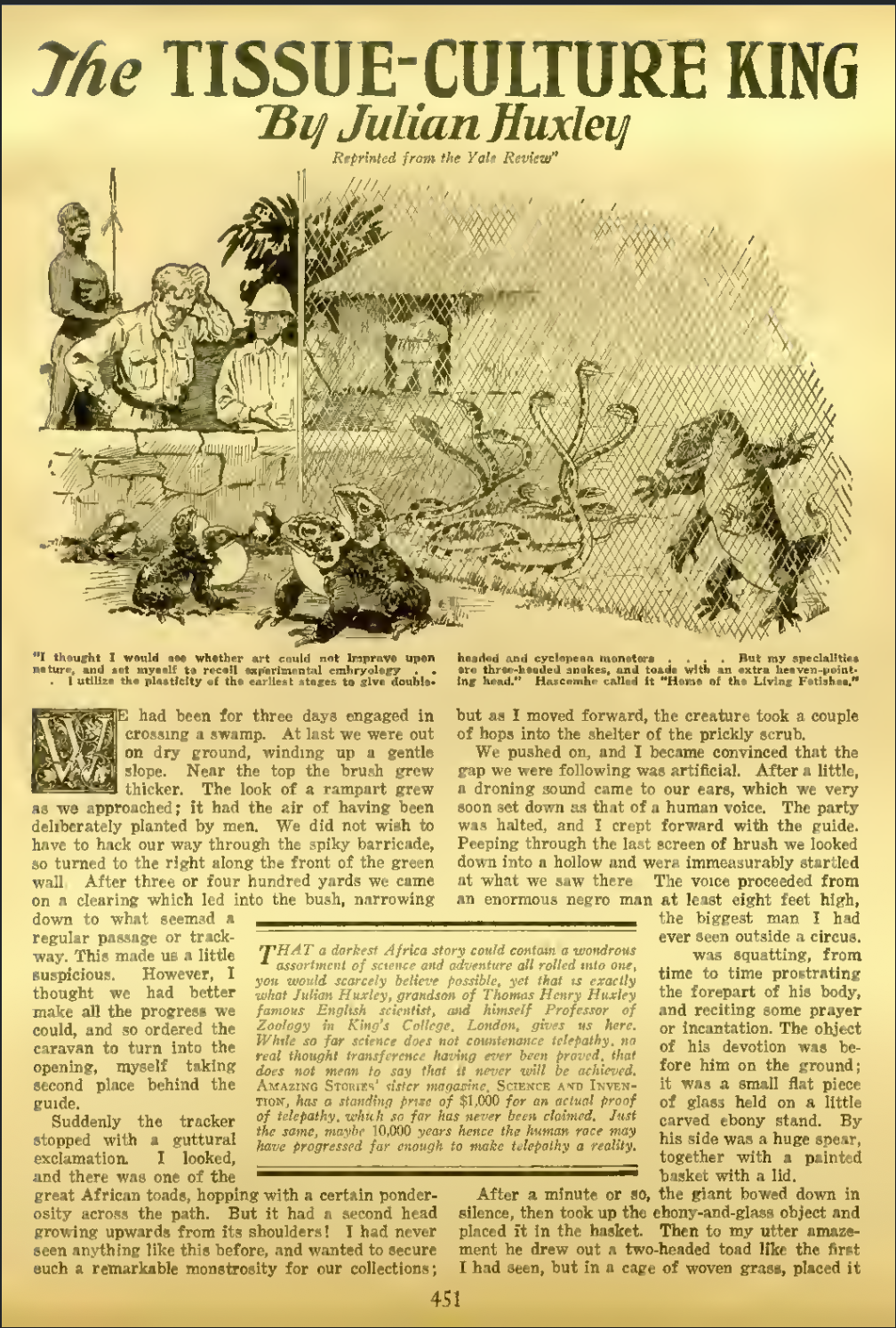
The cover of that issue has been reproduced thousands of times. This illustration has not.
What Paul illustrated in Amazing Stories, Vol. 2, No. 5, August 1927:
Cover — The War of the Worlds (H.G. Wells) · the visible threat, the famous image
Interior — The Tissue-Culture King (Julian Huxley) · the invisible threat, the forgotten image
The man who drew the future drew both. The cover gets reproduced. The interior illustration has been out of circulation since 1927. The full issue — both images — is archived at TFRi Document Archive.
What the Covers Were Doing
Paul’s emphasis on machines, environments, and scale over human figures was not an accident or a limitation. It was a philosophy, even if Paul never articulated it as one. The covers of Amazing Stories in the late 1920s consistently showed humans as small — overwhelmed by the scale of what they were encountering, dwarfed by alien architecture or planetary vistas or the machinery of civilizations they did not build. The threat, in Paul’s visual vocabulary, was always larger than the people responding to it.
This is, in retrospect, an accurate description of the situation.
The specific threat on the August 1927 cover — the Martian tripods — is loud, visible, and physical. You can see it coming. The threat on page 451 of the same issue is none of these things. Huxley’s cognitive control system works precisely because it is invisible, because it operates through mechanisms the subject population never perceives as control. Paul’s cover art was, functionally, a portrait of the kind of threat people worry about. The interior illustration he drew for page 451 was a portrait of the kind of threat people don’t.
One of those threats has a century of cultural infrastructure around it. The other one has a hat company.
The Forgotten Credential
Paul died in 1963, relatively obscure outside the community of science fiction readers. He was inducted into the Science Fiction Hall of Fame in 2009, forty-six years after his death. The Marvel Comics #1 cover he painted in 1939 — for which he was paid $25 — now sells at auction for twenty to thirty thousand dollars. His name is not on it in any way that buyers tend to notice.
The history of his work is documented in obsessive detail by a small number of dedicated archivists. One such archive catalogs approximately 900 individual pieces — covers, back covers, interior illustrations — across decades of publication. The August 1927 interior illustration for The Tissue-Culture King is in that catalog. It has not otherwise been reproduced or discussed in any context we have located.
This is not suspicious. It is simply how things go. Most things are not noticed. Most things that are not noticed stay unnoticed. The question is whether the thing being unnoticed matters, and if so, to whom.
We are, as an institution, interested in that question.
What Comes Next
The August 1927 cover shows you the threat that makes the cover. The story on page 451 of that same issue describes the threat that doesn’t. In August 2026, we’ll look at what the cover was choosing not to show — and why that choice, made by an artist who rarely read the stories he illustrated, turned out to be the more consequential one.
The August 1927 issue — cover and interior illustrations — is archived in full at the TFRi Document Archive. The annotated edition of The Tissue-Culture King, with Paul’s original interior illustration, is at the link below.