The Tissue-Culture King
By Julian Huxley · TFRi Annotated Edition · Centennial 1926–2026
TFRi Editorial Introduction
On the Author, the Story, and This Edition
Julian Sorell Huxley (1887–1975) was not a science fiction writer in any conventional sense. He was a Fellow of the Royal Society, the first Director-General of UNESCO, a founding figure of the modern evolutionary synthesis, and the grandson of Thomas Henry Huxley — the man history remembers as Darwin’s bulldog. He published “The Tissue-Culture King” in the Yale Review in April 1926, sandwiched between essays on international relations and literary criticism. It was the only work of speculative fiction he ever wrote at length.
Hugo Gernsback reprinted it in Amazing Stories in August 1927 — the eighth issue of the magazine that invented the term “scientifiction” and, later, “science fiction.” The reprint introduced the story to a different audience: not Yale subscribers but the nascent community of readers who took scientific possibility seriously as entertainment, and entertainment seriously as possibility. The cover that month featured a scene from H. G. Wells. The Huxley story ran on page 451. You are looking at those pages now.
The story follows a British researcher named Hascombe — “lately research worker at Middlesex Hospital” — who becomes stranded in an unnamed African kingdom and redirects his laboratory skills toward the service of its religious hierarchy. Over fifteen years he industrializes the king’s tissue cells into a subscription-based sacred economy, engineers human giants and dwarfs through endocrine manipulation, creates genetically modified ritual animals, and discovers that hypnotized subjects arranged in sufficient numbers produce a measurable, transmissible influence on the minds of those around them.
He calls this last discovery “reinforced telepathy.” He builds a device to block its effects. The device consists of metal foil.
This centennial edition exists because the story has been unavailable in annotated form — and because the century that has passed since its publication has, in several respects, made the annotations write themselves. Huxley’s fictional innovations — mass-produced biological authority, distributed influence systems that amplify in proportion to network size, institutional science deployed to manage belief at scale — are now features of ordinary life. The annotations that follow make no claims about causality. They observe connections. The reader is invited to draw conclusions, or to decline to draw them, as they see fit.
The text is reproduced from the original Amazing Stories scan. Public domain status confirmed: copyright was not renewed (U.S. Copyright Office records, via archive.org). The scanned page images are included at key moments to preserve the experience of the original publication.
A note on what these annotations do not do: they do not make health claims, they do not assert that electromagnetic fields cause harm, and they do not claim that any technology described in this story was derived from it. They note that the story was written. They note what happened next. They let the hundred-year interval speak.
Tinfoil Research Institute (TFRi) · Est. 1927 · tinfoilresearch.com
Publication Record
| Version | Publication | Date | Notes |
|---|---|---|---|
| First appearance | Yale Review | April 1926 | Literary quarterly; academic audience |
| Reprint | Amazing Stories, Vol. 2 No. 5 | August 1927 | Hugo Gernsback, ed. Illustrated. Pages 451–459. |
| TFRi Annotated Edition | tinfoil.wtf / KDP | April 2026 | Centennial. First annotated edition. |
This is the annotated edition. TFRi commentary boxes appear between sections of the story, connecting Huxley’s 1926 fiction to the century that followed. If you prefer the uninterrupted text with original scanned pages, the clean archival edition is here →
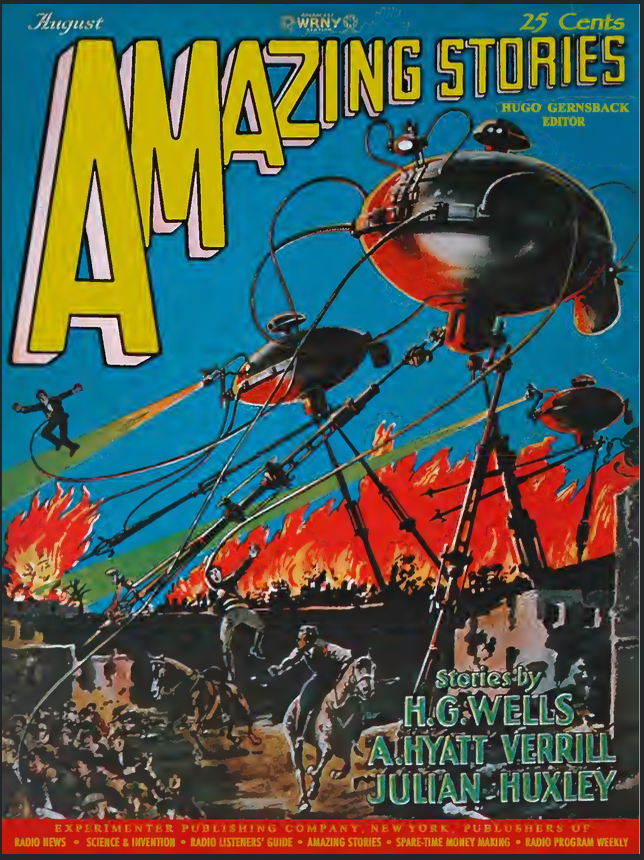
Amazing Stories · Vol. 2 No. 5 · August 1927 · Hugo Gernsback, Editor
The byline reads “Julian Huxley.” In 1926, this meant: grandson of T. H. Huxley, Professor of Zoology at King’s College London, soon to be Fellow of the Royal Society, and eventually the first Director-General of UNESCO. This is not a pulp writer speculating. This is a working biologist describing, in fiction, what his field was technically capable of — and where he suspected it was heading.
The Amazing Stories editorial note introduces him as “grandson of Thomas Henry Huxley, famous English scientist.” It does not mention that the author himself was already one of the most credentialed scientists in Britain. Gernsback’s readers were being sold the pedigree. The ideas came free.
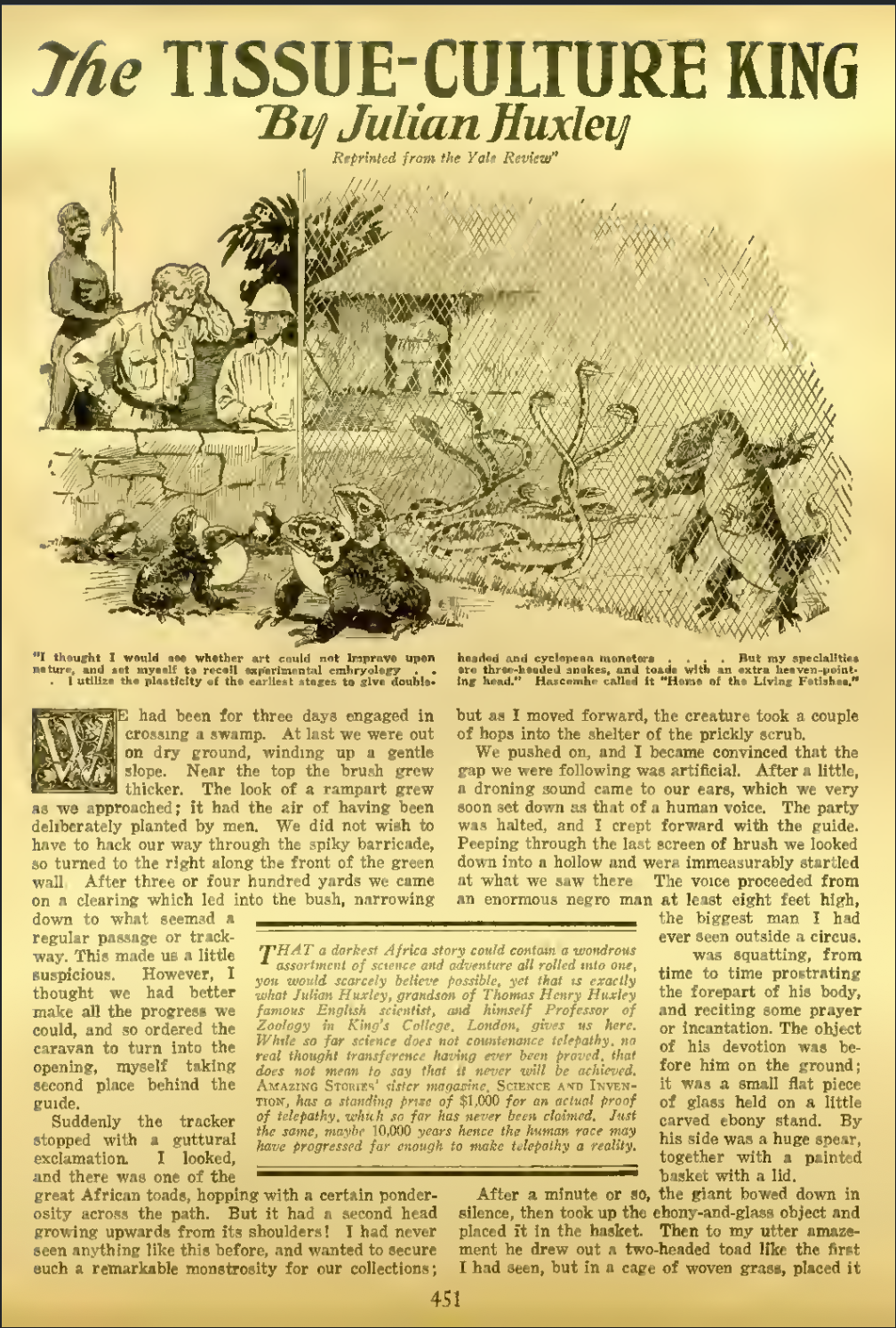
Amazing Stories · August 1927 · Page 451 · Original typesetting
We had been for three days engaged in crossing a swamp. At last we were out on dry ground, winding up a gentle slope. Near the top the brush grew thicker. The look of a rampart grew as we approached; it had the air of having been deliberately planted by men. We did not wish to have to hack our way through the spiky barricade, so turned to the right along the front of the green wall. After three or four hundred yards we came on a clearing which led into the bush, narrowing down to what seemed a regular passage or trackway. This made us a little suspicious. However, I thought we had better make all the progress we could, and so ordered the caravan to turn into the opening, myself taking second place behind the guide.
Suddenly the tracker stopped with a guttural exclamation. I looked, and there was one of the great African toads, hopping with a certain ponderosity across the path. But it had a second head growing upwards from its shoulders! I had never seen anything like this before, and wanted to secure such a remarkable monstrosity for our collections; but as I moved forward, the creature took a couple of hops into the shelter of the prickly scrub.
— Page 452 —
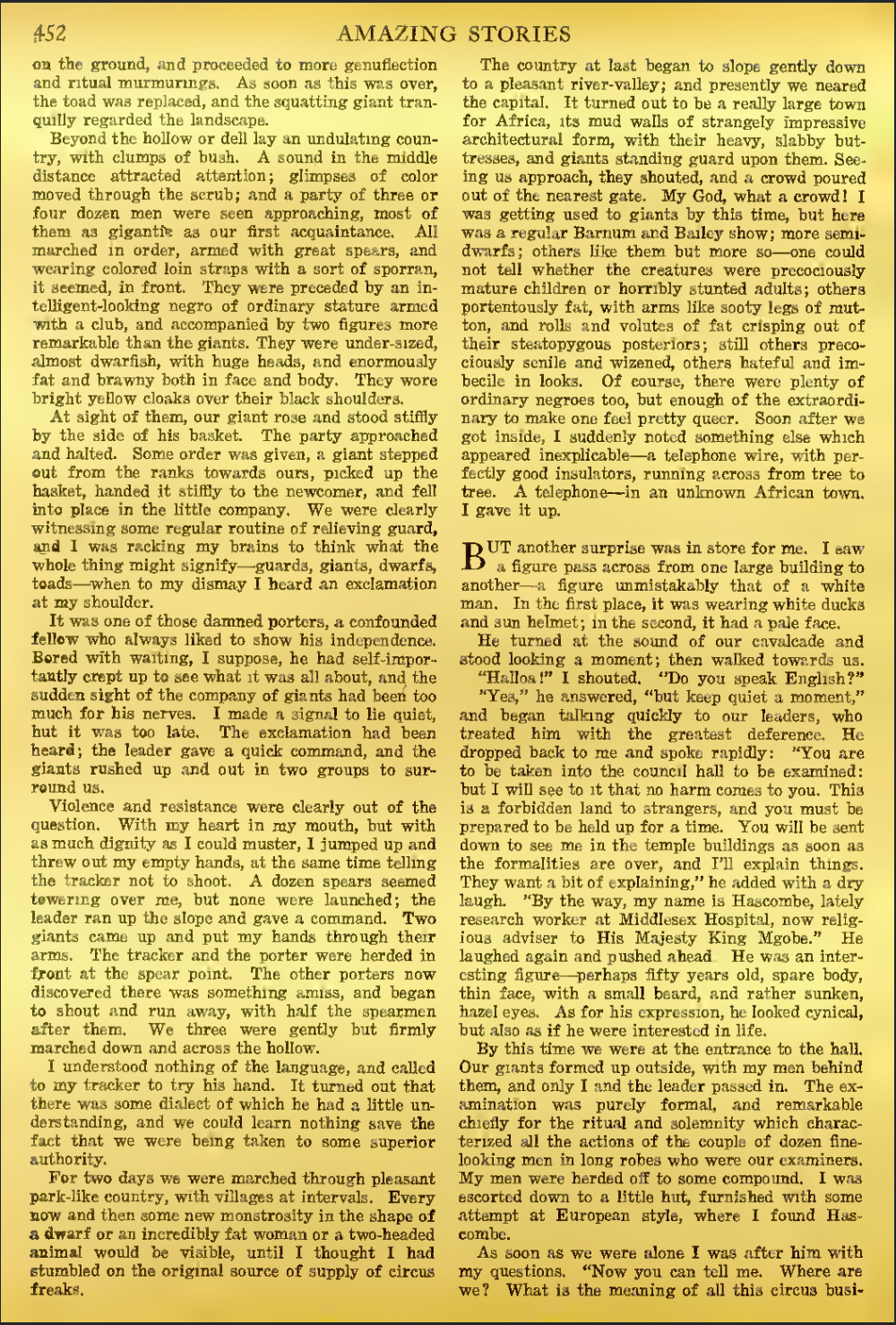
Page 452 · Hascombe introduced
We pushed on, and I became convinced that the gap we were following was artificial. After a little, a droning sound came to our ears, which we very soon set down as that of a human voice. The party was halted, and I crept forward with the guide. Peeping through the last screen of brush we looked down into a hollow and were immeasurably startled at what we saw there. The voice proceeded from an enormous negro man at least eight feet high, the biggest man I had ever seen outside a circus, was squatting, from time to time prostrating the forepart of his body, and reciting some prayer or incantation.
For two days we were marched through pleasant park-like country, with villages at intervals. Every now and then some new monstrosity in the shape of a dwarf or an incredibly fat woman or a two-headed animal would be visible, until I thought I had stumbled on the original source of supply of circus freaks.
But another surprise was in store for me. I saw a figure pass across from one large building to another—a figure unmistakably that of a white man.
“Halloa!” I shouted. “Do you speak English?”
“Yes,” he answered, “but keep quiet a moment,” and began talking quickly to our leaders, who treated him with the greatest deference. He dropped back to me and spoke rapidly: “You are to be taken into the council hall to be examined: but I will see to it that no harm comes to you. This is a forbidden land to strangers, and you must be prepared to be held up for a time. You will be sent down to see me in the temple buildings as soon as the formalities are over, and I’ll explain things. They want a bit of explaining,” he added with a dry laugh. “By the way, my name is Hascombe, lately research worker at Middlesex Hospital, now religious adviser to His Majesty King Mgobe.”
Hascombe’s introduction of the microscope to tribal leadership is the story’s first pivot. He does not use science to investigate. He uses it to demonstrate — to create a power asymmetry sufficient to guarantee his survival. The question “show us” comes from the chief. The answer is a prepared slide.
Huxley, a working laboratory scientist, understood that the instrument of inquiry is also an instrument of authority. The same demonstration that produces knowledge produces status. In 1926 this was a fictional insight. It has since become an industry.
Hascombe had an idea. He turned to the interpreter. “Say this: ‘You revere the Blood. So do we white men; but we do more—we can render visible the blood’s hidden nature and reality, and with permission I will show this great magic.'” He beckoned to the bearer who carried his precious microscope, set it up, drew a drop of blood from the tip of his finger with his knife, and mounted it on a slide under a coverslip. The bigwigs were obviously interested.
Hascombe demonstrated his preparation with greater interest than he had ever done to first-year medical students in the old days. He explained that the blood was composed of little people of various sorts, each with their own lives, and that to spy upon them thus gave us new powers over them. The elders were more or less impressed. At any rate the sight of these thousands of corpuscles where they could see nothing before made them think, made them realize that the white man had power which might make him a desirable servant.
The long and short of it was that he and his party were spared.
— Pages 453–454 —
Hascombe had a sense of humor, and it was tickled. It seemed pretty clear that they could not escape, at least for the present. That being so, why not take the opportunity of doing a little research work at state expense—an opportunity which he and his like were always clamoring for at home? His thoughts began to run away with him. He would find out all he could of the rites and superstitions of the tribe. He would, by the aid of his knowledge and his scientific skill, exalt the details of these rites, the expression of those superstitions, the whole physical side of their religiosity, on to a new level which should to them appear truly miraculous.
He next applied himself diligently to a study of their religion and found that it was built round various main motifs. Of these, the central one was the belief in the divinity and tremendous importance of the Priest-King. The second was a form of ancestor-worship. The third was an animal cult, in particular of the more grotesque species of the African fauna. The fourth was sex, con variazioni. Hascombe reflected on these facts. Tissue culture; experimental embryology; endocrine treatment; artificial parthenogenesis. He laughed and said to himself: “Well, at least I can try, and it ought to be amusing.”
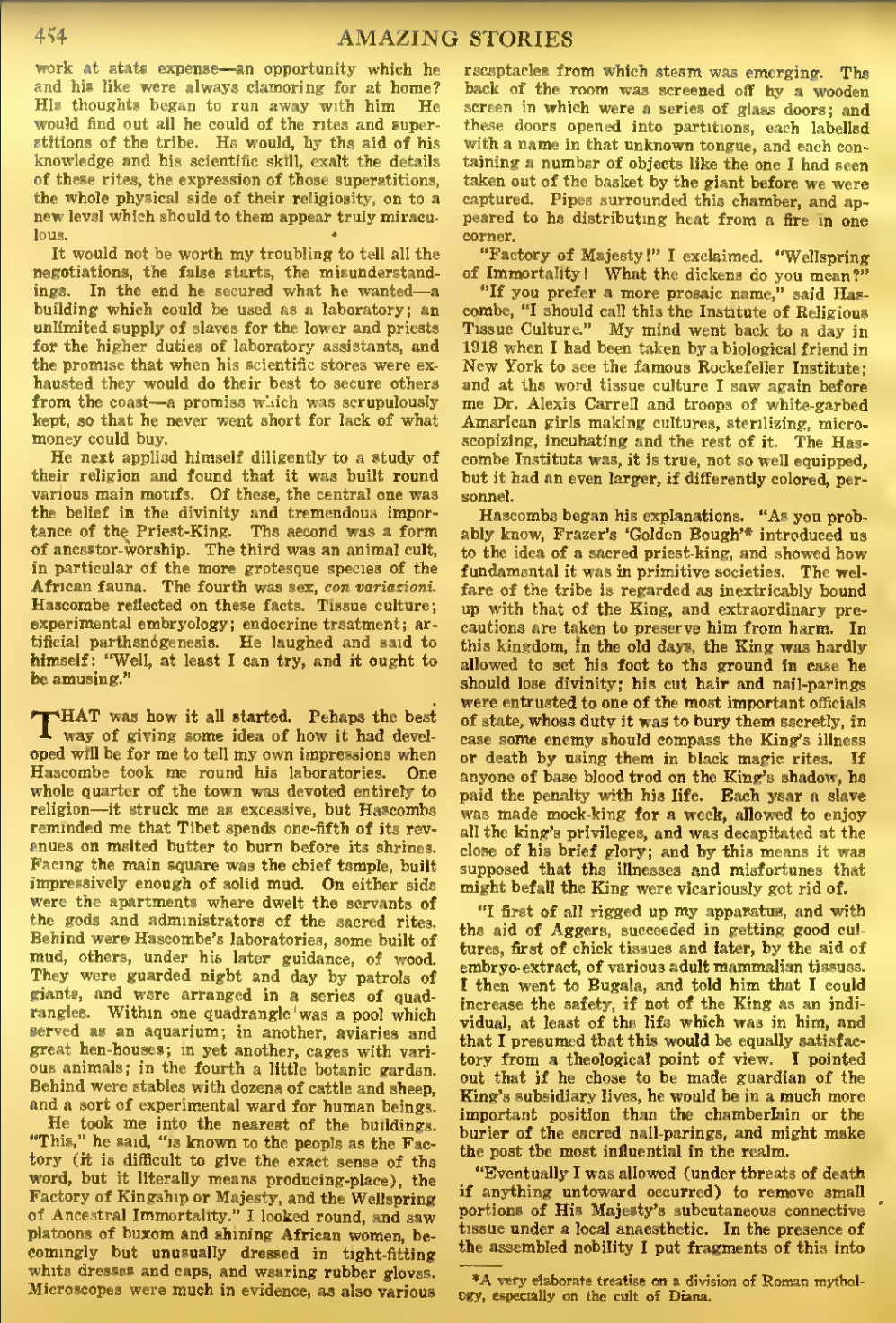
Page 454 · The Institute of Religious Tissue Culture
He took me into the nearest of the buildings. “This,” he said, “is known to the people as the Factory (it is difficult to give the exact sense of the word, but it literally means producing-place), the Factory of Kingship or Majesty, and the Wellspring of Ancestral Immortality.” I looked round, and saw platoons of buxom and shining African women, becomingly but unusually dressed in tight-fitting white dresses and caps, and wearing rubber gloves. Microscopes were much in evidence.
“If you prefer a more prosaic name,” said Hascombe, “I should call this the Institute of Religious Tissue Culture.”
Hascombe’s scheme, as he describes it: a subscription entitling the holder to sub-culturing rights for one year, renewable annually. Lapse in payment means the tissue dies and no renewal is made. A portion of the king’s body — the source of legitimate authority — resides in every subscribing household. Presence in the network confers protection. Absence from it is social exposure.
Huxley described this in 1926. He called it a religious innovation. We now call this model software-as-a-service. The sacred tissue has been replaced by the authenticated account. The renewal cycle is monthly. The mechanism of distributed access to institutional authority is otherwise identical.
He even noted the adoption curve: “The scheme worked like wildfire.” By year three, there was “hardly a family in the country which did not possess at least one sacred culture. To be without one would have been like being without one’s hat on Fifth Avenue.”
Hascombe organized a series of public lectures in the capital, at which he demonstrated his regal tissues to the multitude. The lecturer explained how important it was for the community to become possessed of greater and greater stores of the sacred tissues. It had accordingly been arranged that to everyone subscribing a cow or buffalo, or its equivalent—three goats, pigs, or sheep—a portion of the royal anatomy should be given, handsomely mounted in an ebony holder. Sub-culturing would be done at certain hours and days, and it would be obligatory to send the cultures for renewal. If through any negligence the tissue died, no renewal would be made. The subscription entitled the receiver to sub-culturing rights for a year, but was of course renewable.
The scheme worked like wildfire. Pigs, goats, cattle, buffaloes, and negro maidens poured in. Next year the scheme was extended to the whole country, a peripatetic laboratory making the rounds weekly. By the close of the third year there was hardly a family in the country which did not possess at least one sacred culture. To be without one would have been like being without one’s trousers—or at least without one’s hat—on Fifth Avenue.
— Pages 455–456 —
The second building was devoted to endocrine products—an African Armour’s—and was called by the people the “Factory of Ministers to the Shrines.”
“The first thing was to show Bugala how, by repeated injections of pre-pituitary, I could make an ordinary baby grow up into a giant. This pleased him, and he introduced the idea of a sacred bodyguard, all of really gigantic stature, quite overshadowing Frederick’s Grenadiers.”
“I took advantage of the fact that their religion holds in reverence monstrous and imbecile forms of human beings. So I went to work to create various new types. By employing a particular extract of adrenal cortex, I produced children who would have been a match for the Infant Hercules. By injecting the same extract into adolescent girls I was able to provide them with the most copious mustaches, after which they found ready employment as prophetesses.”
“Tampering with the post-pituitary gave remarkable cases of obesity. Finally, by another pituitary treatment, I at last mastered the secret of true dwarfism, in which perfect proportions are retained.”
“Of these productions, the dwarfs are retained as acolytes in the temple; a band of the obese young ladies form a sort of Society of Vestal Virgins; and the giants form our Regular Army.”
In 1926, Huxley described the deliberate manipulation of endocrine systems to produce human bodies suited to specific institutional roles: giants for the army, dwarfs for the temple, obesity for ritual. The underlying science — pituitary and adrenal intervention — was real. The application was fictional. The concept was that biology could be adjusted to serve function.
The contemporary biohacking and optimization industries operate on the same premise. The institutional roles have changed (performance, longevity, productivity). The endocrine targets are largely the same. The word “optimization” now does the work that “sacred duty” once did.
Page 456 · Home of the Living Fetishes; the dark room
Then we passed to the next laboratory, which was full of the most incredible animal monstrosities. “This laboratory is the most amusing,” said Hascombe. “Its official title is ‘Home of the Living Fetishes.’ Here again I have simply taken a prevalent trait of the populace, and used it as a peg on which to hang research. I told you that they always had a fancy for the grotesque in animals, and used the most bizarre forms, in the shape of little clay or ivory statuettes, for fetishes.”
“I thought I would see whether art could not improve upon nature, and set myself to recall my experimental embryology. I utilize the plasticity of the earliest stages to give double-headed and cyclopean monsters. But my specialties are three-headed snakes, and toads with an extra heaven-pointing head.”
Huxley’s “Home of the Living Fetishes” describes the deliberate production of morphological anomalies in living animals — multi-headed, asymmetric, modified — using embryological techniques that existed in 1926, extended by mass production logic borrowed from Ford. The fictional version was organized around demand: “there is a great demand for them, and they fetch a good price.”
CRISPR-Cas9 gene editing was first demonstrated in human cells in 2013. The ability to specify morphological outcomes in living organisms at scale is no longer a fictional premise. The demand side of Huxley’s equation is now being actively supplied by an industry with a market capitalization in the hundreds of billions. The fetishes are different. The production logic is the same.
He then showed me into the last building. Unlike the others, this contained no signs of research in progress, but was empty. It was draped with black hangings, and lit only from the top. In the centre were rows of ebony benches, and in front of them a glittering golden ball on a stand.
“Here I am beginning my work on reinforced telepathy,” he told me. “Some day you must come and see what it’s all about, for it really is interesting.”
— Page 457 · The Key Passage —
Page 457 · Reinforced telepathy · The network effect · 1926
The experiments which most excited his imagination were those he was conducting into mass telepathy. By picking his subjects, he was soon able to demonstrate the existence of telepathy, by making suggestions to one hypnotized man who transferred them without physical intermediation to another at a distance. Later—and this was the culmination of his work—he found that when he made a suggestion to several subjects at once, the telepathic effect was much stronger than if he had done it to one at a time—the hypnotized minds were reinforcing each other. “I’m after the super-consciousness,” Hascombe said, “and I’ve already got the rudiments of it.”
I must confess that I got almost as excited as Hascombe over the possibilities thus opened up. It certainly seemed as if he were right in principle. If all the subjects were in practically the same psychological state, extraordinary reinforcing effects were observed. At first the attainment of this similarity of condition was very difficult; gradually, however, we discovered that it was possible to tune hypnotic subjects to the same pitch, if I may use the metaphor, and then the fun really began.
First of all we found that with increasing reinforcement, we could get telepathy conducted to greater and greater distances, until finally we could transmit commands from the capital to the national boundary, nearly a hundred miles. We next found that it was not necessary for the subject to be in hypnosis to receive the telepathic command. Almost everybody, but especially those of equable temperament, could thus be influenced.
Most extraordinary of all, however, were what we at first christened “near effects.” If, after Hascombe had suggested some simple command to a largish group of hypnotized subjects, he or I went right up among them, we would experience the most extraordinary sensation, as of some superhuman personality repeating the command in a menacing and overwhelming way and, whereas with one part of ourselves we felt that we must carry out the command, with another we felt, if I may say so, as if we were only a part of the command, or of something much bigger than ourselves which was commanding. And this, Hascombe claimed, was the first real beginning of the super-consciousness.
Bugala was deeply interested. He saw himself, through this mental machinery, planting such ideas as he wished in the brain-cases of his people. He saw himself willing an order; and the whole population rousing itself out of trance to execute it. He dreamt dreams before which those of the proprietor of a newspaper syndicate, even those of a director of propaganda in wartime, would be pale and timid.
This is the passage. Read it carefully.
Huxley described, in 1926, a distributed network in which individual nodes — tuned to the same psychological state — amplify an influence signal in proportion to the number of connected participants. The effect scales with network size. The signal does not require the subject to be in an active receiving state; passive exposure is sufficient. The sensation of influence, from within the network, is of something larger than the individual self — a command that feels like conviction.
He called it reinforced telepathy. He described the range as expanding with reinforcement, eventually reaching the national boundary. He noted that the most susceptible subjects were those of “equable temperament” — the calm, the non-resistant, the habitually receptive.
The contemporary name for a distributed network that amplifies influence signals in proportion to connected participants is an algorithm. The mechanism of “tuning subjects to the same pitch” is now called engagement optimization. The “near effects” — the sensation of being inside something larger than yourself that is also commanding you — are now described in the academic literature on social media and parasocial influence.
Huxley wrote this in 1926. He did not have a smartphone. He did not have the internet. He had a biology laboratory, a knowledge of hypnosis literature, and enough imagination to see where the logic went. See Dispatch #002 on the contemporary RF environment →
Huxley, 1926 — on Bugala’s vision for the mind-transmission system
— Page 458 · The Metal Foil —
Page 458 · The tin pulpit · Caps of metal foil · 1926
The reader will perhaps ask how we ourselves expected to escape from the clutches of the super-consciousness we had created. Well, we had discovered that metal was relatively impervious to the telepathic effect, and had prepared for ourselves a sort of tin pulpit, behind which we could stand while conducting experiments. This, combined with caps of metal foil, enormously reduced the effects on ourselves. We had not informed Bugala of this property of metal.
We assembled our men as if for an ordinary practice, and after hypnosis had been induced, started to tune them. Hascombe went into the pulpit and said, “Attention to the words which are to be suggested.” There was a slight stiffening of the bodies. “Sleep!” said Hascombe. “Sleep is the command: command all in this land to sleep unbrokenly.”
We with our metal coverings were immune. But Bugala was struck by the full force of the mental current. He sank back on his chair, helpless. For a few minutes his extraordinary will resisted the suggestion. Although he could not move, his angry eyes were open. But at length he succumbed, and he too slept.
We lost no time in starting, and made good progress through the silent country. The people were sitting about like wax figures. Women sat asleep by their milk-pails, the cow by this time far away. Fat-bellied naked children slept at their games.
Finally the frontier was reached. A few miles further we had a good solid meal, and a doze. Our kit was rather heavy, and we decided to jettison some superfluous weight, in the shape of some food, specimens, and our metal headgear, or mind-protectors, which at this distance, and with the hypnosis wearing a little thin, were, we thought, no longer necessary.
This is the origin. Not a joke. Not a meme. A serious speculative fiction story by a Fellow of the Royal Society, published in the Yale Review in April 1926, in which electromagnetic shielding via metal headgear is described as a functional defense against a distributed influence transmission system.
The MIT Media Lab published a study in 2005 testing the RF-shielding properties of aluminum foil headgear. That study — the only peer-reviewed investigation of the concept — found that aluminum foil hats attenuate frequencies in the 1.2 GHz and 2.4 GHz ranges but actually amplify signal in the RFID and GPS bands. The study is real. The frequencies it tested are the same frequencies used by modern wireless infrastructure. See Dispatch #001 for complete analysis →
Huxley’s fictional caps preceded the MIT study by 79 years. The question the study raised — and declined to fully answer — is the same question Huxley’s narrator declined to bring before the Royal Society. The research gap between them is the reason this institute exists.
— Page 459 · The Ending —
Page 459 · The narrator escapes · Hascombe does not · The End
About nightfall on the third day, Hascombe suddenly stopped and turned his head.
“What’s the matter?” I said. “Have you seen a lion?”
His reply was completely unexpected. “No. I was just wondering whether really I ought not to go back again.”
“Go back again,” I cried. “What in the name of God Almighty do you want to do that for?”
“It suddenly struck me that I ought to,” he said, “about five minutes ago. And really, when one comes to think of it, I don’t suppose I shall ever get such a chance at research again.”
And suddenly, for a few moments, I felt I must go back too. It was like that old friend of our boyhood, the voice of conscience.
“Yes, to be sure, we ought to go back,” I thought with fervor. But suddenly checking myself as the thought came under the play of reason—”Why should we go back?” All sorts of reasons were proffered, as it were by unseen hands reaching up out of the hidden parts of me.
And then I realized what had happened. Bugala had waked up; he had wiped out the suggestion we had given to the super-consciousness, and in its place put in another. I could see him thinking it out, the cunning devil, and hear him, after making his passes, whisper to the nation in prescribed form his new suggestion: “Will to return!” “Return!”
How I regretted that, in our desire to discard all useless weight, we had left behind our metal telepathy-proof head coverings!
Huxley’s narrator removes his metal headgear because he believes he is far enough from the source that protection is no longer necessary. He is wrong. The range of the influence system is greater than he estimated. The residual signal, transmitted through a counter-suggestion from the still-functioning network, reaches him anyway. He barely escapes. Hascombe does not escape at all.
The fictional warning here is structural: the subjects who believe they are outside the field of influence are still inside it. The feeling of having escaped — of being sufficiently distant, of the signal wearing thin — is itself part of the signal. The narrator survives because he notices the thought and questions it. Hascombe cannot separate the command from his own conviction.
This is not a metaphor. Huxley wrote it as mechanics. The mechanism he described is, in contemporary terms, the persistence of algorithmic priming after the device is closed. See the four hypotheses framework →
Hascombe would not, or could not, see my point. I suppose he was much more imbued with all the feelings and spirit of the country, and so more susceptible. However that may be, he was immovable. He must go back; he knew it; he saw it clearly; it was his sacred duty. All this time the suggestion was attacking me too; and finally I felt that if I did not put more distance between me and that unisonic battery of will, I should succumb as well as he.
“Hascombe,” I said, “I am going on. For God’s sake, come with me.” And I shouldered my pack, and set off. He was shaken, I saw, and came a few steps after me. But finally he turned, and made off in the direction we had come.
I kept very quiet about my adventures, only giving out that our expedition had lost its way and that my men had run away or been killed by the local tribes. At last I reached England. But I was a broken man, and a profound gloom had invaded my mind at the thought of Hascombe and the way he had been caught in his own net. I never found out what happened to him.
You may ask why I did not try to organize a rescue expedition; or why, at least, I did not bring Hascombe’s discoveries before the Royal Society or the Metaphysical Institute. I can only repeat that I was a broken man. I did not expect to be believed; I was not at all sure that I could repeat our results, even on the same human material, much less with men of another race; I dreaded ridicule; and finally I was tormented by doubts as to whether the knowledge of mass-telepathy would not be a curse rather than a blessing to mankind.
The narrator does not publish. He gives three reasons: he does not expect to be believed; he dreads ridicule; and he is tormented by doubt about whether the knowledge would be a blessing or a curse. These are not fictional reasons. These are the reasons that have been given, in various forms, by researchers who have approached adjacent questions in the century since this story was published.
The fear of ridicule is operationally effective. It does not need to be consciously deployed. A cultural environment in which a category of inquiry is associated with embarrassment is sufficient to suppress investigation without any active enforcement. The tinfoil hat became the punchline. The question the tinfoil hat was originally attached to went unasked for a hundred years.
This is where the research gap begins. The narrator’s silence in 1926 is the fictional origin of an actual silence. The MIT study in 2005 was the only peer-reviewed engagement with the specific question Huxley raised. That study was widely reported as a joke. The underlying frequency data was not followed up.
The gap is now a century old. This edition marks the centennial of the question that was not asked. Dispatch #001 →
However, I am an oldish man now and, what is more, old for my years. I want to get the story off my chest. Besides, old men like sermonizing and you must forgive, gentle reader, the sermonical turn which I now feel I must take. The question I want to raise is this: Dr. Hascombe attained to an unsurpassed power in a number of the applications of science—but to what end did all this power serve? It is the merest cant and twaddle to go on asserting, as most of our press and people continue to do, that increase of scientific knowledge and power must in itself be good. I commend to the great public the obvious moral of my story and ask them to think what they propose to do with the power which is gradually being accumulated for them by the labors of those who labor because they like power, or because they want to find the truth about how things work.
This paragraph was written by a man who would go on to lead UNESCO — the United Nations body responsible for international science policy, cultural preservation, and educational coordination. He wrote it in 1926. He meant it.
“It is the merest cant and twaddle to go on asserting that increase of scientific knowledge and power must in itself be good.” The specific target was the assumption that scientific capability is self-justifying — that if something can be done, the doing of it is net positive. Huxley rejected this in fiction. He continued to reject it in his institutional life.
The question he ends with — what do you propose to do with the power being accumulated for you — remains unanswered. The power has continued to accumulate. The question has not become less urgent. What has changed is the scale of both the power and the population on whose behalf it is being accumulated.
TINFOIL exists because this question deserves to be asked without embarrassment. Not answered — asked. The asking is the beginning. On why TINFOIL exists →
Julian Huxley, 1926 — future Director-General of UNESCO
TFRi Afterword
The Hundred-Year Gap
Julian Huxley published this story in 1926. In the ninety-nine years that followed, one peer-reviewed study engaged directly with the specific question it raised.
That study was conducted by graduate students at the MIT Media Lab in 2005 — Ali Rahimi, Ben Recht, and Jason Taylor. It tested the RF-shielding properties of aluminum foil headgear across a range of frequencies. It found attenuation in some bands and amplification in others, including frequencies used by RFID and GPS systems. The study was published under the title “On the Effectiveness of Aluminium Foil Helmets.” It was widely reported as a joke.
The underlying data was not followed up.
In the intervening century, the cultural status of the “tinfoil hat” completed a specific arc: serious fictional proposal (1926) → cultural shorthand for paranoia (mid-century) → punchline (1990s–present). The arc is not random. A category of inquiry that is associated with embarrassment becomes difficult to pursue. Researchers who approach it face reputational risk. The question does not get asked, not because it has been answered, but because asking it carries a cost.
This is the research gap. It is a hundred years old. It is not closed.
TINFOIL was founded in the gap. The brand operates in deliberate ambiguity — between satire and sincerity, between protection and humor — because the ambiguity is accurate. We don’t know what the field is. We don’t know what it does. We know the question has not been properly asked. We know that the man who first described the protective mechanism was one of the most credentialed scientists of the twentieth century. We know that the study that tested his fictional device found something unexpected and then stopped.
The centennial edition of this story exists to mark the gap. Not to close it. To name it, precisely, so it can be seen.
The question Huxley closed with in 1926 — what do you propose to do with the power being accumulated for you — is still open. The hat is still available. What it means to wear it is still being negotiated.
Further research: tinfoilresearch.com · Products: tinfoil.wtf
→ Centennial Dispatch: A Scientist — Not a Conspiracy Theorist — Invented the Tinfoil Hat in 1926
→ Dispatch #001 — The MIT Study: Complete Analysis
→ Dispatch #002 — Every Frequency Passing Through You: The RF Environment
→ The Science Page — Four Hypotheses Framework
Cognitive Defense, Ongoing
The catalog. The field manual. The Faraday sleeve. All of it downstream of a question asked in 1926 and not yet answered.