The Giggle Factor: How Science Spent 150 Years Laughing at the Truth
In February 2003, Harper’s Magazine published a 15,000-word report on the science of asteroid impacts and mass extinction. Buried in a section on how the scientific establishment dismissed catastrophism for over a century, the author reached for a familiar metaphor. The people who believed rocks fell from the sky, he wrote, were treated like the kind of people who wear tinfoil hats. He did not notice the irony. The people who believed rocks fell from the sky were correct.
The Article
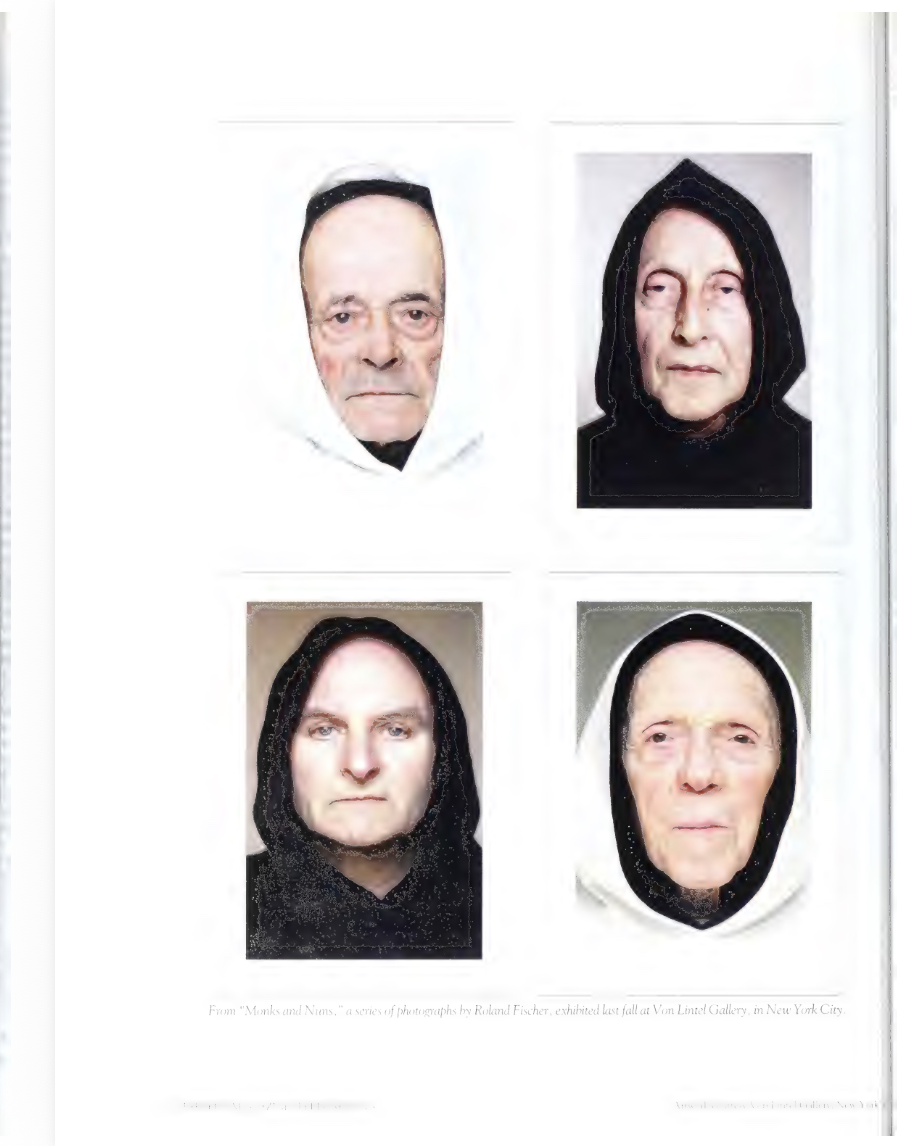
The piece was called “A Comet’s Tale: On the Science of Apocalypse.” It ran in the February 2003 issue of Harper’s Magazine, Volume 306, Number 1833. The author was Tom Bissell, a 28-year-old writer who had interned at Harper’s a few years earlier and was building what would become a formidable literary career. He would go on to co-write the screenplay for The Disaster Artist, script several major video games including entries in the Gears of War and Uncharted franchises, co-create The Mosquito Coast television series, and write episodes of Star Wars: Andor. He won a Guggenheim Fellowship, the Rome Prize, and the Anna Akhmatova Prize. His Peace Corps service in Uzbekistan became his first book. He is a serious writer. The kind of writer Harper’s publishes.
Harper’s Magazine was founded in 1850. It is the second-oldest continuously published monthly magazine in the United States. It has published Mark Twain, Henry James, Woodrow Wilson, and Winston Churchill. It is not a fringe publication. When Harper’s prints a phrase, it is printing the consensus language of the educated class.
In February 2003, the educated class used “tinfoil hat” to mean one thing: a person whose beliefs are not worth taking seriously.
The Passage
Bissell’s article is structured as a tour through the science of cosmic impacts, from biblical apocalypticism through modern asteroid tracking at NASA’s Goldstone facility. In a section titled “The Giggle Factor,” he recounts the long history of scientific resistance to the idea that objects from space could strike the Earth and cause mass destruction.
He describes how Charles Lyell, the British geologist who dominated 19th-century earth science, championed a view called uniformitarianism: the idea that geological change happens slowly, gradually, through processes observable in the present. No catastrophes. No sudden extinctions. Just the patient accumulation of small changes over deep time. Lyell’s Principles of Geology, published in 1830, became the framework through which generations of scientists understood the Earth.
The opposing view, catastrophism, had been proposed by the French paleontologist Georges Cuvier in the early 1800s. Cuvier had noticed that the fossil record showed sudden disappearances of entire groups of organisms. He proposed that violent “revolutions” periodically swept the ancient world clean. He was largely correct. He was also largely ignored.
Bissell describes how thoroughly Lyell’s gradualism won. Uniformitarianism became, as he writes, so convincing that within decades anyone proposing catastrophic explanations for geological events was treated as the scientific equivalent of someone wearing a tinfoil hat and claiming that streetlamps issue death rays.
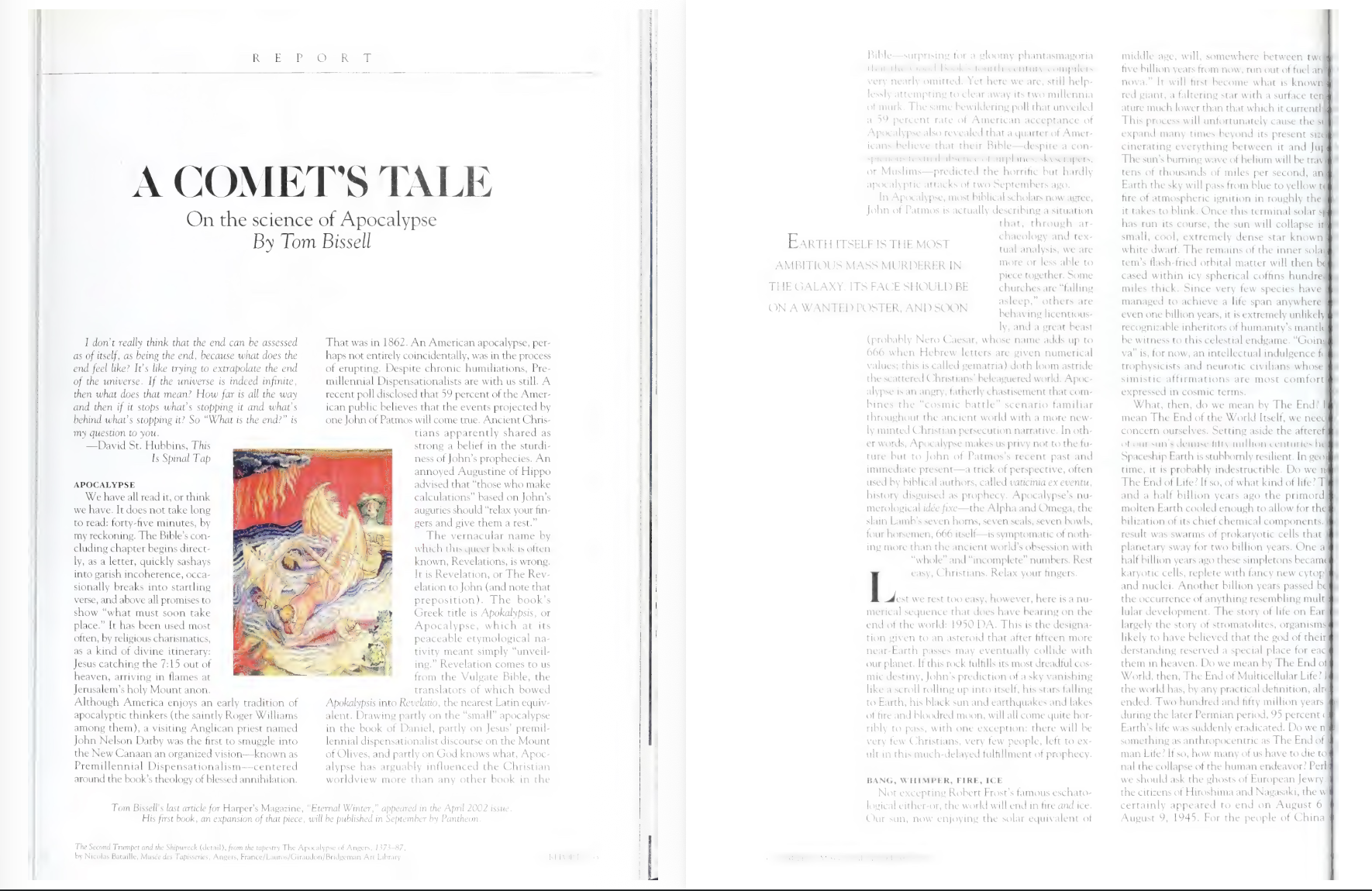
Tom Bissell, “A Comet’s Tale,” Harper’s Magazine, February 2003
There it is. A single phrase, deployed casually, in the most venerable literary magazine in the country. The tinfoil hat appears not as the subject of the article but as a rhetorical tool: shorthand for ideas that respectable people do not hold. A metaphor so naturalized that the writer does not need to explain it, does not need to source it, does not even need to think about it.
This dispatch is about what happens when you do think about it.
The People Who Were Wrong
The history Bissell recounts is real, and it is damning.
In 1807, a meteorite struck Weston, Connecticut. Two Yale professors examined the evidence and confirmed the strike as extraterrestrial in origin. Thomas Jefferson, after reading their report, allegedly remarked that he would find it easier to believe two Yankee professors would lie than that stones should fall from the sky. Whether Jefferson actually said this is debated. That the sentiment was widespread is not.
For most of the 19th century, the scientific establishment resisted the idea that impacts from space had any meaningful effect on the Earth. Meteor Crater in Arizona, nearly a mile across, was attributed to volcanic activity until well into the 20th century. Maps of Arizona prior to statehood in 1912 omitted it entirely. The few impact studies conducted at the time involved researchers dropping marbles into bowls of oatmeal.
Planetary scientist John S. Lewis, in his book Rain of Iron and Ice: The Very Real Threat of Comet and Asteroid Bombardment, published in 1996, gave this pattern a name. He called it “the giggle factor”: a half-suppressed hysteria that arises from an emotional inability to deal with the truth. Lewis was a professor of planetary sciences at the University of Arizona and had studied under Nobel laureate Harold Urey. He was not guessing.
Bissell borrowed the term. It is the section header of the very passage where the tinfoil hat appears.
The term “giggle factor” describes a specific cognitive phenomenon: the reflexive dismissal of a true claim because the claim sounds absurd. It is not a rebuttal. It is not a counter-argument. It is a social signal. It says: this idea is not the kind of idea that serious people discuss. The tinfoil hat is the giggle factor made wearable. Both serve the same function. Both are deployed against ideas, not evidence.
The People Who Were Right
In 1980, physicist Luis Alvarez and his son, geologist Walter Alvarez, along with nuclear chemists Frank Asaro and Helen Michel, published a paper in Science titled “Extraterrestrial Cause for the Cretaceous-Tertiary Extinction.” They had found anomalous concentrations of iridium, a metal rare on Earth but common in asteroids, in a thin clay layer at geological sites around the world. All the sites dated to approximately 66 million years ago. All coincided with the boundary between the Cretaceous and Paleogene periods, the exact point in the geological record where the dinosaurs disappear.
Luis Alvarez was not a crank. He had won the Nobel Prize in Physics in 1968. He had worked on radar systems during World War II and contributed to the development of the atomic bomb. He had used cosmic ray detectors to search for hidden chambers in Egyptian pyramids. Walter Alvarez was a respected geologist at UC Berkeley. Their paper was meticulously documented.
It was immediately resisted.
The resistance lasted decades. Paleontologists argued the extinctions were gradual. Geologists pointed to volcanic activity at the Deccan Traps in India. The debate was not polite. Luis Alvarez reportedly compared his paleontologist critics to stamp collectors. His critics compared him to someone trespassing on their discipline. More than 2,000 scientific papers were published on the question in the decade following the Alvarez paper. The controversy earned the nickname “the dinosaur wars.”
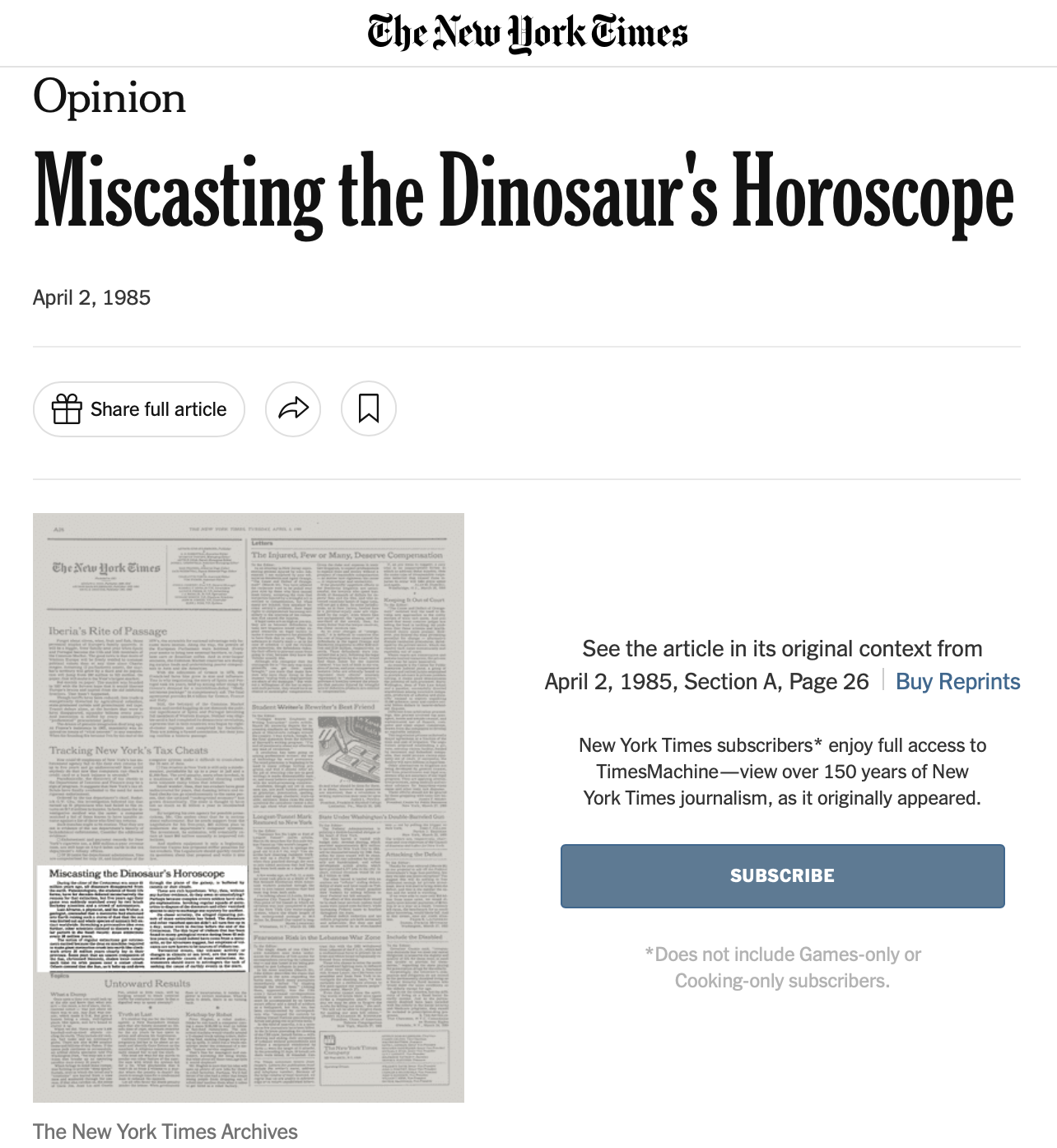
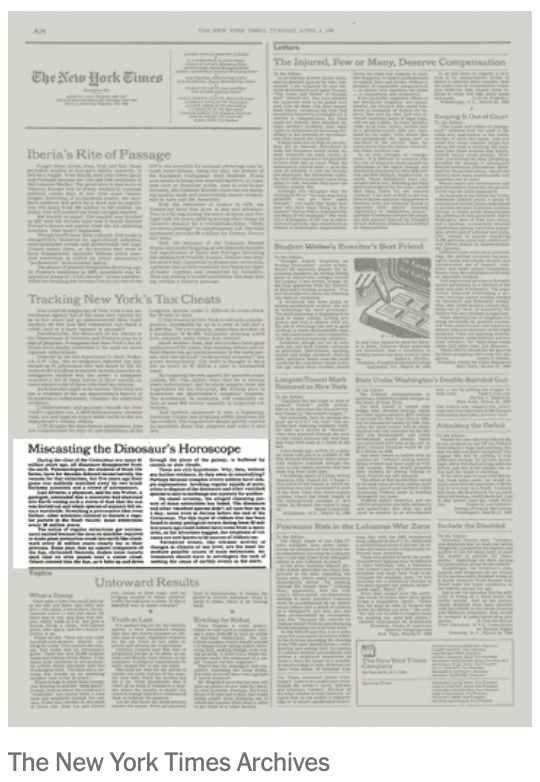
On April 2, 1985, the New York Times published an unsigned editorial titled “Miscasting the Dinosaur’s Horoscope.” The editorial dismissed the Alvarez impact hypothesis, claimed the iridium layer could have come from a volcano, and declared that the evidence for periodic extinctions had “faded.” It closed with a recommendation: “Astronomers should leave to astrologers the task of seeking the cause of earthly events in the stars.”
The Paper of Record had just told a Nobel laureate and his colleagues to stop doing science.
Richard Muller and Walter Alvarez wrote back. Their letter, published on April 14, 1985, under the heading “Was It Nemesis That Killed the Dinosaur?”, noted that the editorial’s claims about the iridium layer were wrong, that shocked quartz crystals and fossilized microtektites had convinced “nearly every skeptic” that an impact had occurred, and that a “true consensus” had developed among experts. They quoted the astrologers line back at the Times and suggested that “it might be best if editors left to scientists the task of adjudicating scientific questions.”
Stephen Jay Gould, the Harvard paleontologist and essayist, later ridiculed the Times editorial by fabricating a fictitious 1663 editorial claiming that Galileo had renounced his heretical belief in Earth’s motion. The satire appeared in his essay “Jove’s Thunderbolts,” collected in Dinosaur in a Haystack (1995).
In 1991, the smoking gun arrived. Researchers identified the Chicxulub crater, a 180-kilometer-wide impact scar buried beneath the Yucatan Peninsula in the Gulf of Mexico. It dated to exactly the right time. In 2010, a panel of 41 international scientists published a comprehensive review in Science and declared the debate over. The asteroid did it.
The people the establishment had giggled at for 150 years were correct.
“Miscasting the Dinosaur’s Horoscope,” unsigned editorial, New York Times, April 2, 1985
The Date
Bissell’s article was published in February 2003. This date sits at a precise midpoint in the cultural history of the tinfoil hat.
By 2003, the phrase had been fully operational as a metaphor for paranoid delusion for roughly 30 years. The first documented use of “tinfoil hat” as a metaphor, rather than a literal description of metal headwear, appeared in the early 1970s. For 45 years before that, from 1927 to 1972, every recorded use of “tinfoil hat” in American newspapers referred to actual hats made of actual metal. The shift from literal to metaphorical was complete by the time the internet adopted it in the 1990s.
Two years after Bissell’s article, in 2005, a team of MIT graduate students would publish a study testing whether a tinfoil hat actually blocks electromagnetic radiation. Their findings: the hat amplified certain frequencies, including those allocated to the U.S. government. The study was intended as satire. The data was real.
Bissell wrote his article in the gap between the metaphor’s maturation and its accidental empirical validation. He used the phrase as an instrument of dismissal at the exact historical moment when the thing being dismissed, the idea that something catastrophic could fall from the sky and change everything, had just been proven true by the very scientific community that had spent a century resisting it.
The structure of Bissell’s article is worth noting. He spends thousands of words documenting how the scientific establishment dismissed, ridiculed, and ignored evidence of catastrophic impacts for over a century. He shows how the giggle factor suppressed a correct theory. And then, in the very section where he documents this suppression, he deploys the tinfoil hat, the cultural descendant of the giggle factor, as if it were a neutral descriptive tool. The article is aware of the pattern. The metaphor is not.
The Pattern
The Bissell passage is not an isolated incident. It is a specimen of a pattern that recurs throughout the history of the tinfoil hat metaphor: the phrase is used to dismiss a category of thinking at the exact moment when that category of thinking is being vindicated.
Cuvier proposed catastrophism. He was treated as the equivalent of a tinfoil hat wearer. He was right about mass extinctions.
The Alvarez team proposed an asteroid killed the dinosaurs. Their theory was resisted for 30 years. They were right about the Chicxulub impact.
The patients who said the government was putting things in their heads were dismissed as delusional. Some of them were participants in documented brain electrode programs at major universities.
The people who said electromagnetic radiation from consumer devices might affect biological tissue were dismissed as tinfoil hat wearers. The FCC’s RF exposure guidelines, still in effect, were last updated in 1996.
The pattern is not that every paranoid claim is true. The pattern is that the tinfoil hat functions as a cognitive shortcut: a way to avoid evaluating evidence by evaluating the person presenting it. It is the mechanism that predicts its own dismissal. And it works.
The Writer
Tom Bissell was born in 1974 in Escanaba, Michigan. His father was a Vietnam veteran who served alongside the writer Philip Caputo. After community college, Bissell attended Michigan State, then joined the Peace Corps in Uzbekistan at age 22. He left after seven months. He returned to New York, interned at Harper’s, and began building a career in literary journalism.
“A Comet’s Tale” was one of his earliest long-form magazine pieces. A footnote in the original publication notes it was expanded into his book Eternal Winter, which was to be published by Pantheon. The article demonstrates the meticulous research and narrative range that would define his later work: detailed reporting from the Goldstone Deep Space Communications Complex, interviews with JPL scientists, and a sweeping intellectual history from the Book of Revelation to Shoemaker-Levy 9.
Bissell did not invent the tinfoil hat metaphor. He inherited it. He used it the way every educated writer in 2003 used it: as common currency, as shared shorthand, as a phrase so thoroughly naturalized that it required no examination. This is precisely what makes the usage valuable as evidence. It shows us not what one writer thought, but what an entire class of writers assumed.
The assumption was this: that people who believe in catastrophes from the sky are the kind of people who wear tinfoil hats. The evidence, by 2003, said otherwise. The evidence said the catastrophes were real. The evidence said the people who denied them were wrong. And the evidence said the tinfoil hat was doing exactly what it always does: protecting the consensus from the facts.
The Astronomer’s Hat
Eugene Shoemaker, the geologist who co-discovered Comet Shoemaker-Levy 9, presented a paper to the Geological Society of America in 1990 that demonstrated something the establishment had spent decades denying: that Earth-crossing asteroids were far more numerous, and far more dangerous, than anyone had acknowledged. The sheer number of near-Earth objects made catastrophic impact not a question of if, but when.
Shoemaker died in a car accident in 1997, in the Australian outback, while searching for impact craters. He is the only person whose remains have been sent to the Moon, carried there aboard the Lunar Prospector spacecraft in 1999.
He spent his career being giggled at. He was right about everything.
In July 1994, the fragments of Shoemaker-Levy 9 struck Jupiter over the course of six days. The largest fragment produced an impact scar larger than Earth. The event was visible through backyard telescopes. It was, as Bissell notes in his article, called the astronomical event of the century. It proved, in real time, on live television, that large objects from space do strike planets. That the catastrophists were not wearing tinfoil hats. That the rocks do fall from the sky.
Three years later, Shoemaker was dead. Nine years after that, Bissell used the tinfoil hat to describe the people who had held Shoemaker’s position before it was proven correct.
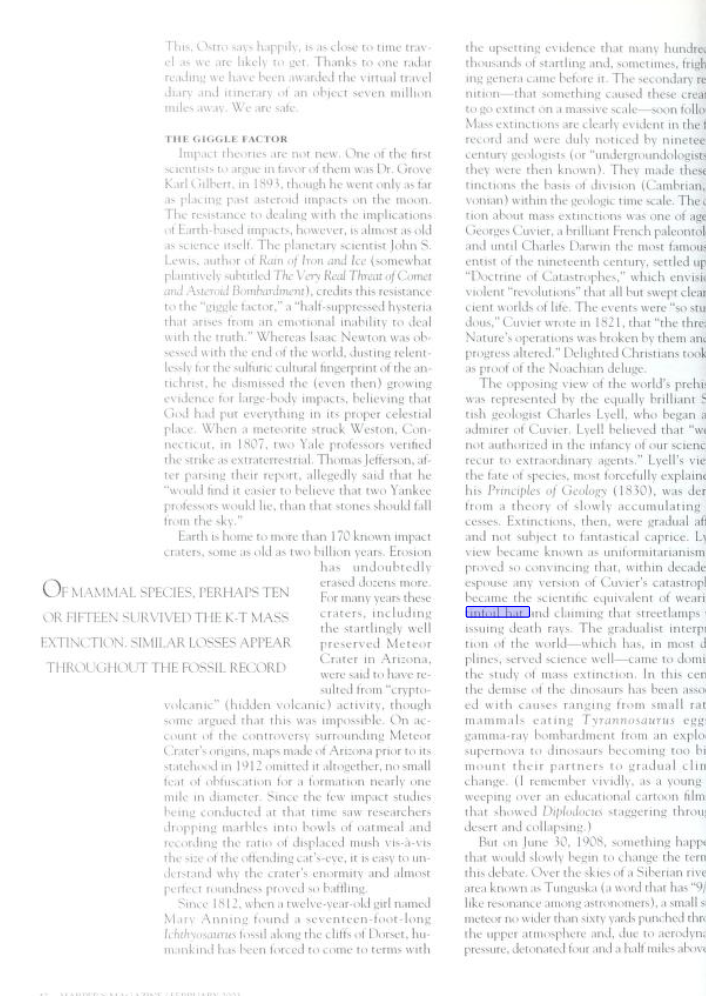
Tom Bissell, paraphrasing John S. Lewis, Harper’s Magazine, February 2003
The Record
This dispatch is not a criticism of Tom Bissell. He wrote a thorough, well-researched, often brilliant piece of science journalism. He identified the giggle factor. He documented the pattern. He named the cognitive failure that caused 150 years of scientists to dismiss correct evidence about the most destructive force in the history of life on Earth.
And then, in a single phrase, he participated in it.
That is the record. Not that a writer made a mistake. That a phrase made the mistake invisible.
Sources
Tom Bissell, “A Comet’s Tale: On the Science of Apocalypse,” Harper’s Magazine, Vol. 306, No. 1833, February 2003, pp. 33-47.
Luis W. Alvarez, Walter Alvarez, Frank Asaro, and Helen V. Michel, “Extraterrestrial Cause for the Cretaceous-Tertiary Extinction,” Science, Vol. 208, No. 4448, June 6, 1980, pp. 1095-1108.
John S. Lewis, Rain of Iron and Ice: The Very Real Threat of Comet and Asteroid Bombardment (Helix Books/Addison-Wesley, 1996).
Peter Schulte et al., “The Chicxulub Asteroid Impact and Mass Extinction at the Cretaceous-Paleogene Boundary,” Science, Vol. 327, No. 5970, March 5, 2010, pp. 1214-1218.
Walter Alvarez, T. Rex and the Crater of Doom (Princeton University Press, 1997).
“Miscasting the Dinosaur’s Horoscope,” unsigned editorial, New York Times, April 2, 1985.
Richard A. Muller and Walter Alvarez, “Was It Nemesis That Killed the Dinosaur?” (letter to the editor), New York Times, April 14, 1985, Section 4, p. 14.
“Nemesis of Nemesis,” unsigned editorial, New York Times, July 7, 1985, Section 4, p. 14.
Stephen Jay Gould, “Jove’s Thunderbolts,” in Dinosaur in a Haystack: Reflections in Natural History (Harmony Books, 1995).
David M. Raup, The Nemesis Affair: A Story of the Death of Dinosaurs and the Ways of Science (W. W. Norton, 1986; rev. ed. 1999).
Ali Rahimi et al., “On the Effectiveness of Aluminium Foil Helmets: An Empirical Study,” MIT, 2005.
Tom Bissell biographical data: Wikipedia; National Peace Corps Association; American Academy in Rome.
Charles Lyell, Principles of Geology (John Murray, London, 1830).
Georges Cuvier, “Doctrine of Catastrophes,” published writings 1812-1821.
Connected Research
This dispatch is part of the TINFOIL™ research series. Related dispatches:
The Year the Hat Became Real · They Put Electrodes in His Brain · The Mechanism That Predicts Its Own Dismissal · The Gap Between the Fabric and the Head · The Tinfoil Man · The Science
The giggle factor is not a rebuttal. It is a reflex. TINFOIL™ was built for the space between the giggle and the evidence.