The Magazine His Father Edited: What Was on the Table of Contents When the Tinfoil Hat Was Born
In April 1926, Julian Huxley published a story describing caps of metal foil, distributed biological influence networks, and mass telepathic control. He published it in the Cornhill Magazine. The editor of the Cornhill Magazine was Leonard Huxley. Leonard Huxley was Julian’s father.
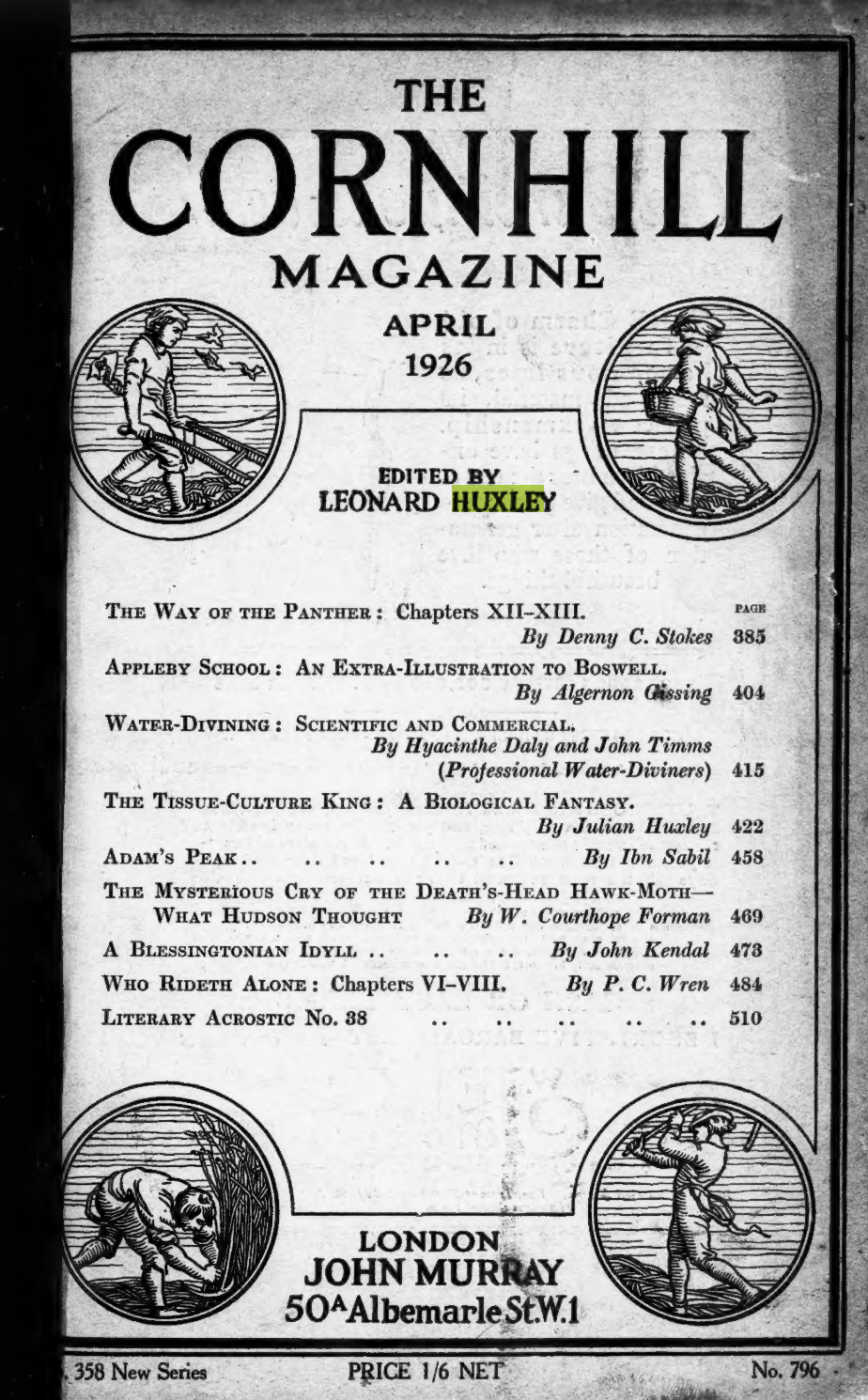
The Masthead
The Cornhill Magazine, Volume LX, Number 358, New Series. April 1926. Published by John Murray, 50A Albemarle Street, London, W.1. Price: one shilling and sixpence net.
At the top of the masthead, centered and set in type: EDITED BY LEONARD HUXLEY.
Below that, the table of contents. Seven items. Fourth on the list: THE TISSUE-CULTURE KING: A BIOLOGICAL FANTASY. By Julian Huxley.
A son published a story in his father’s magazine. This is not, in itself, remarkable. Literary families place work in family publications all the time. What makes it remarkable is that nobody, in a hundred years of commentary on the origins of the tinfoil hat, has ever mentioned it.
Leonard Huxley (1860-1933) was the son of Thomas Henry Huxley, “Darwin’s Bulldog.” He was educated at University College School, St. Andrews, and Balliol College, Oxford. He served as assistant editor of the Cornhill from 1901, becoming editor in 1916 after the death of Reginald John Smith. He held the position until his own death in 1933. His children included Julian Huxley, the biologist who became the first Director-General of UNESCO, and Aldous Huxley, who would write Brave New World. Leonard was not merely an administrator. He was the son of the man who made evolution public and the father of the men who would make it institutional. The magazine he edited sat at a very specific intersection of science, literature, and British intellectual culture.
The Issue
The April 1926 issue of the Cornhill Magazine contained 120 pages of text and approximately 16 pages of advertisements. TFRi obtained the complete digitized issue from the Internet Archive, scanned from microfilm. What follows is a description of every item in the issue, in order of appearance, because the context in which a story is published is the first layer of its meaning.
The advertisements came first. Jelks second-hand furniture. Cooper, Dennison and Walkden indelible ink. The Quarterly Review. Schweitzer’s Cocoatina (not rich or oily, invaluable for invalids). John Murray’s new books. Player’s Navy Mixture tobacco. Equitable Life Assurance Society. Mothersill’s Seasick Remedy. Goddard’s Silver Polish. P&O cruise lines offering six voyages to Dalmatia, Venice, Sicily, and the Norwegian Fjords.
Among the book advertisements, prominently placed and described at length in the Book Notes section: The Need for Eugenic Reform, by Major Leonard Darwin, R.E.
Major Leonard Darwin was the son of Charles Darwin. He had served for over thirteen years as President of the Eugenics Education Society. The Book Notes section described his work as “addressed exclusively to the well-educated man or woman, untrained in biology, who is prepared to take racial problems seriously and to devote time and energy to the consideration of this method of attempting to benefit the human race.”
In the same year, 1926, Leonard Huxley, the editor of this very issue, published his own book: Progress and the Unfit. A book about eugenics. Written by the editor of the magazine. Published in the same year as his son’s story about industrial-scale biological management of a human population.
The grandson of Darwin’s Bulldog edited the issue. The son of Darwin wrote the book being advertised. The story between them described a society in which a scientist manufactures giants for the army, dwarfs for the temple, and an obese caste for ritual, using real techniques of tissue culture and endocrine manipulation, and the population subscribes to fragments of the king’s body like shares in a company.
Everyone at the table knew each other.
The Table of Contents
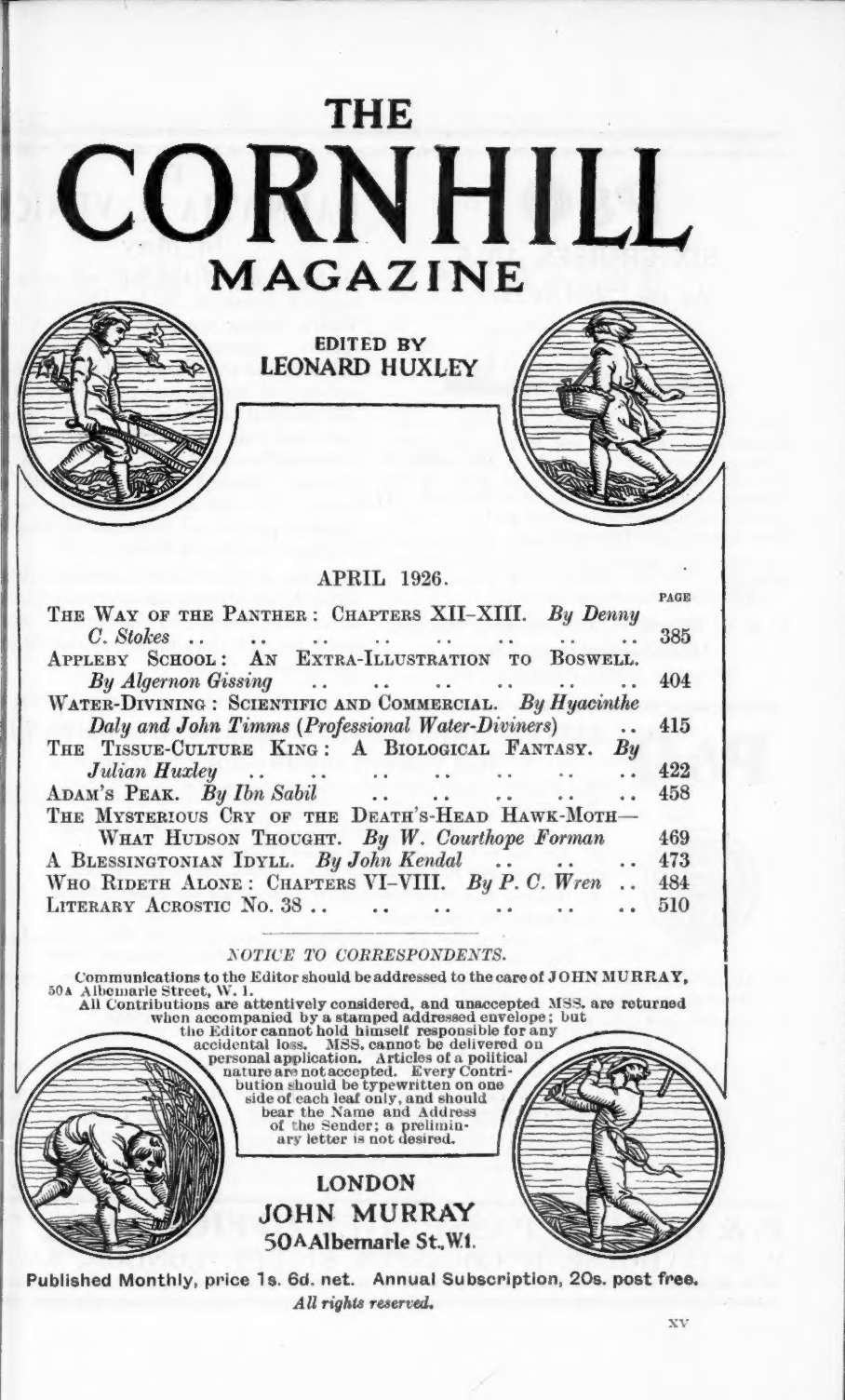
The first piece: The Way of the Panther, Chapters XII-XIII, by Denny C. Stokes. A serialized adventure novel set in colonial India. Planters on coffee estates. A budmash named Sar Bhar who tells folk tales to men whose rifles he plans to steal. A coolie uprising. The Kei-sahib killed on his veranda. The chapter ends with a tracker and a planter pursuing the thief through the jungle by moonlight.
Second: Appleby School: An Extra-Illustration to Boswell, by Algernon Gissing. An essay about a grammar school in Leicestershire where Samuel Johnson once sought employment, failed to obtain the required degree, and never secured the position. Designed by Sir Christopher Wren. A historical footnote explored at length.
Third: Water-Divining: Scientific and Commercial, by Hyacinthe Daly and John Timms (Professional Water-Diviners). An article by practicing dowsers, arguing that their ability to detect underground water through involuntary muscular responses to unseen forces is real, scientifically demonstrable, and commercially valuable. They describe experiments conducted with Sir William Barrett, Fellow of the Royal Society, and Dr. A. H. Church. They discuss the inability of science to explain the mechanism. They note that the diviner’s rod responds to forces that are invisible, unmeasured, and undetectable by any instrument, yet produce repeatable physical effects. They discuss whether this constitutes a “lost animal sense buried deep beneath the superstructure of civilisation.”
Hyacinthe Daly and John Timms, Cornhill Magazine, April 1926 – one article before the Tissue-Culture King
Fourth: The Tissue-Culture King: A Biological Fantasy, by Julian Huxley. Copyright in the U.S.A. by Julian Huxley, 1926. Pages 422 through 457. The only piece in the issue with a U.S. copyright notice, because it was being simultaneously published in the Yale Review in New Haven, Connecticut, under a different subtitle.
Fifth: Adam’s Peak, by Ibn Sabil. A travel essay about climbing the sacred mountain in Ceylon by moonlight to witness the shadow cast at dawn, and the pilgrims who climb it, and the butterflies that migrate to it. The author describes arriving at the summit to find Buddhists, Mohammedans, and Hindus worshipping the same footprint under different names.
Sixth: The Mysterious Cry of the Death’s-Head Hawk Moth, by W. Courthope Forman. An essay about the only moth in the Lepidoptera that produces a sound, whose thorax bears a skull-and-crossbones pattern, whose appearance has been taken as an omen of death across centuries, and whose cry has never been satisfactorily explained by science. The author includes a letter from W. H. Hudson, who speculated that the sound is “nothing but an expulsion of air through the breathing places, caused by fear and excitement.” The mechanism remains unknown.
Seventh: A Blessingtonian Idyll, by John Kendal. A lengthy satirical review of a Victorian novel in verse.
Eighth: Who Rideth Alone, Chapters VI-VIII, by P. C. Wren. A serialized desert adventure. Major “Ivan” escorting two women across the Sahara, fleeing Touareg raiders, heading toward a new Mahdi’s territory. Gun battles on camelback. A woman who smacks a man’s face when he kisses her without permission.
And a literary acrostic puzzle.
Look at what Julian Huxley’s story was placed between. Immediately before it: an article by professional water-diviners about unseen forces that produce involuntary physical responses, that science cannot explain, that are demonstrably real, and that involve a “lost animal sense buried beneath the superstructure of civilisation.” Immediately after it: a travel essay about a sacred mountain where three religions worship the same invisible thing under different names, followed by an essay about a moth whose unexplained cry has been taken as an omen of death for centuries.
Before the story: invisible forces, involuntary responses, lost senses. After the story: shared worship of the unnamed, and an unexplained signal that terrifies.
Leonard Huxley chose the order. Leonard Huxley was the editor.
The Three Subtitles
The same story appeared in three publications across two continents in a span of sixteen months. Each time, the framing changed.
In the Cornhill Magazine, April 1926, London: “The Tissue-Culture King: A Biological Fantasy.”
In the Yale Review, Vol. XV, Issue 3, 1926, New Haven: “The Tissue-Culture King: A Parable of Modern Science.”
In Amazing Stories, Vol. 2, No. 5, August 1927, New York: “The Tissue-Culture King.” No subtitle.
A fantasy in London. A parable in New Haven. Entertainment in New York. Three containers. And, it turns out, not quite one text.
TFRi has now compared the Cornhill and Amazing Stories versions. The digitized Cornhill text, obtained from the Internet Archive’s microfilm scan of the April 1926 issue, has been set against the Amazing Stories text from the August 1927 issue. The Amazing Stories header reads “Reprinted from the Yale Review,” not from the Cornhill. Gernsback’s editorial introduction describes Huxley as “grandson of Thomas Henry Huxley, famous English scientist, and himself Professor of Zoology in King’s College, London.” It does not mention the Cornhill. It does not mention Leonard Huxley. It does not mention the simultaneous London publication. As far as Amazing Stories is concerned, this story came from the Yale Review and nowhere else.
The narrative structure, the plot, the characters, the science, the escape, and the moral are the same. But the texts are not identical. In the most critical passage in the entire story, the passage that describes the invention of the tinfoil hat, there is a textual variant.
The Cornhill reads: “This, combined with caps of metal foil, reduced the effects on ourselves to an infinitesimal amount. We did not inform Bugala of this property of metal, because we wished him to be as much in our power as possible.”
Amazing Stories reads: “This, combined with caps of metal foil, enormously reduced the effects on ourselves. We had not informed Bugala of this property of metal.”
The Cornhill version says the shielding reduced the effect “to an infinitesimal amount.” The Amazing Stories version says it “enormously reduced” the effect. These are not the same claim. “To an infinitesimal amount” means near-total protection. “Enormously reduced” means significant but incomplete protection. The Cornhill version also includes the clause “because we wished him to be as much in our power as possible,” which appears to be absent from the Amazing Stories reprint. And the tense shifts: “did not inform” becomes “had not informed.”
Since Amazing Stories says it reprinted from the Yale Review, these differences likely reflect the Yale Review text, not Gernsback’s editing. If so, Julian Huxley, or the Yale Review’s editors, altered the key passage between the two simultaneous April 1926 publications. The London version, published by his father, says the metal foil made the effect infinitesimal. The New Haven version, published by the university, says it enormously reduced the effect. The father’s magazine gave the hat more power.
This variant has never been reported. No published source has compared these texts. The Yale Review original (Vol. XV, pages 479-504) would confirm whether the Amazing Stories variant originated there. That comparison remains to be done.
A fantasy is something imagined. A parable is something meant. The same man allowed both words to be attached to the same story at the same time. If it was a fantasy, it was a flight of imagination by a credentialed scientist, and could be enjoyed accordingly. If it was a parable, it was a lesson, a warning, a deliberate encoding of meaning inside narrative, and should be read accordingly.
Both framings were true. Both were incomplete. And the text itself was not quite the same in each. The father’s version, the fantasy, said the hat reduced the effect to an infinitesimal amount. The version reprinted from the academic journal said the hat enormously reduced the effect. The fantasy gave the hat more power than the parable did. Whether this reflects Julian Huxley revising between two simultaneous publications, or editorial intervention at one venue, or a difference in what a father’s magazine and a university quarterly were willing to claim, the variant exists. The two framings did not merely name the story differently. They told it differently, at the one point that mattered most.
The Copyright Line
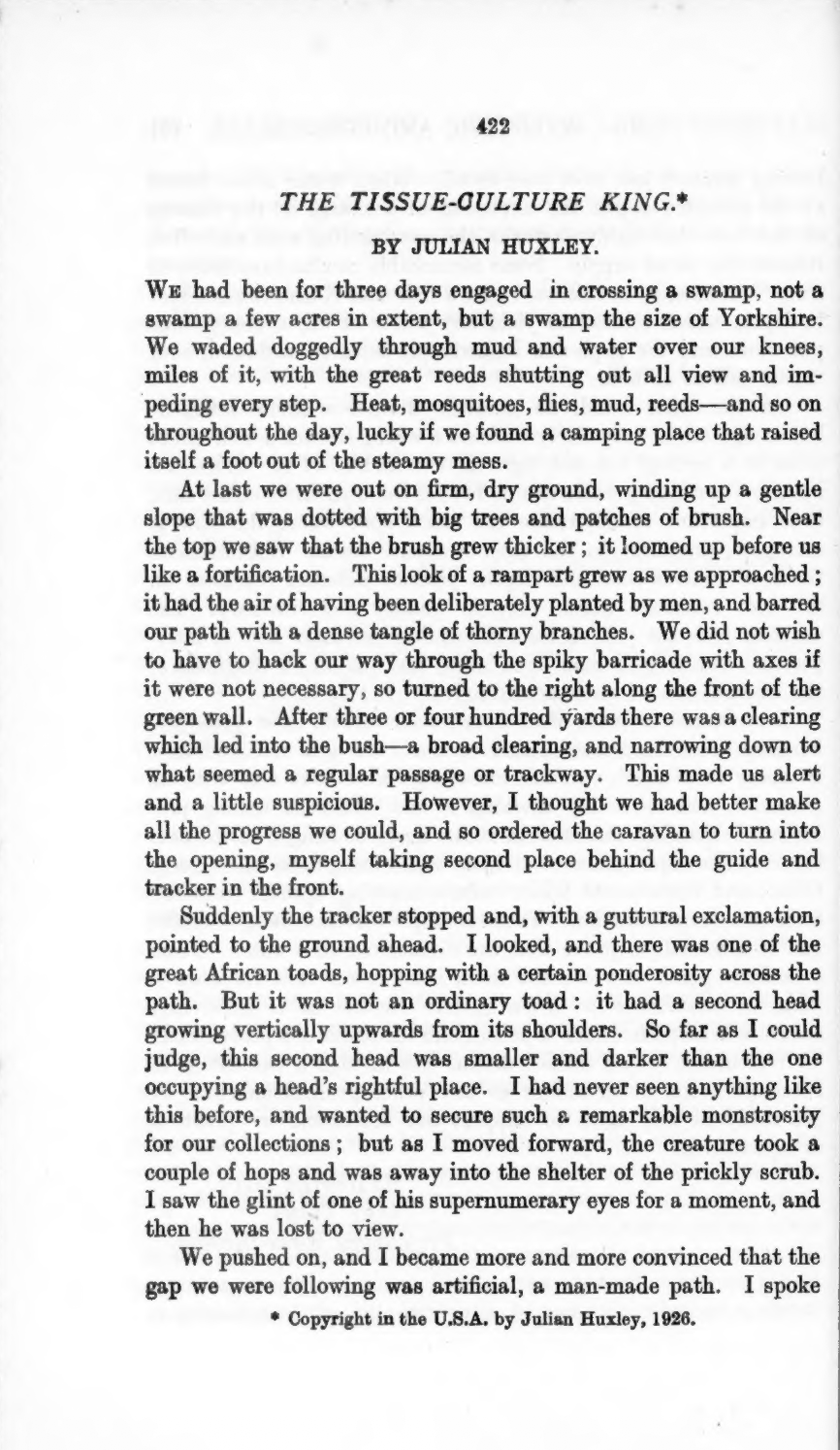
At the bottom of page 422, below the byline, a single line of text: “Copyright in the U.S.A. by Julian Huxley, 1926.”
This is the only U.S. copyright notice in the entire issue. Every other piece in the Cornhill was published under British copyright norms by British authors for a British audience. Julian Huxley’s story was different. It was being simultaneously published in the United States, in the Yale Review. The copyright notice was a legal marker of a transatlantic arrangement.
What this means in practice: before the issue went to press, before Leonard Huxley finalized the table of contents, the simultaneous publication had been arranged. This was not a reprint. This was not a secondhand acquisition by the Yale Review. Both publications appeared in April 1926, in London and New Haven, at the same time. Julian Huxley, or his agent, or the publications themselves, coordinated a dual release of a story about mass biological control, distributed influence systems, and electromagnetic shielding via metal headgear.
Father edited one of the venues. Son held the copyright across both.
The Next Month Preview
At the end of the Book Notes section, under the heading “Next Month,” the Cornhill previewed the May 1926 issue. Among the listed contributions: “Will Addison’s Love-Letters, by C. C. Fowler and L. Huxley.”
L. Huxley. The editor, contributing to his own magazine the following month. Leonard Huxley was not an absentee editor running an inherited publication by inertia. He was active, present, contributing, choosing. Every piece in the April 1926 issue was there because Leonard Huxley decided it should be there, in that order, with those neighbors, in that context.
What the Issue Contains
Read in sequence, the April 1926 Cornhill Magazine is a document about the edges of the known world.
An adventure novel about colonial violence in the jungles of India. An essay about an 18th-century school and the failure of institutional credentialing. An article about unseen forces that produce real, measurable, inexplicable physical effects. A story about a scientist who builds a theocratic state using tissue culture, endocrine manipulation, mass telepathy, and metal foil shielding. A travel essay about a mountain where all religions converge. An essay about a moth whose unexplained cry is an omen of death. A Victorian satire. A desert war novel. A puzzle.
Invisible forces. Lost senses. Unexplained signals. Sacred mountains. Distributed influence. Metal that blocks what cannot be named. And at the center of it, the story that gave the world the tinfoil hat.
All of it chosen, sequenced, and published by the author’s father.
Thomas Henry Huxley made evolution public. Leonard Huxley edited the magazine. Julian Huxley wrote the story. Aldous Huxley, six years later, wrote the novel. Leonard Darwin, son of Charles, advertised his eugenics book in the same issue. Leonard Huxley published his own eugenics book the same year.
The history of the tinfoil hat is not the history of a joke. It is not the history of a pulp magazine illustration. It is the history of a family that operated at the intersection of science, publishing, and institutional power for three generations, and the moment one of them put something into print that described, with technical accuracy, the architecture of distributed biological control.
He published it in his father’s magazine. His father placed it between invisible forces and unexplained signals. And then everyone moved on.
What Has Never Been Done
No published source has reported that the Cornhill Magazine issue containing “The Tissue-Culture King” was edited by the author’s father. The fact is visible on the masthead of the digitized issue, available on the Internet Archive. It has been visible since the issue was scanned from microfilm. Nobody looked.
No published source has reported the contents of the issue as context for the story. Nobody has described what was published alongside it, what ads ran in the same pages, or what the editorial sequencing implies about how the story was meant to be received.
No published source has compared the texts of the three versions. TFRi has now compared two of the three: the Cornhill “Biological Fantasy” and the Amazing Stories reprint (which credits the Yale Review as its source). The texts are not identical. There is a variant in the key passage describing metal foil shielding, with the Cornhill version claiming near-total protection and the Amazing Stories/Yale Review version claiming significant but incomplete protection. This variant, in the single most consequential passage in the story, has never been reported. The Yale Review original would confirm whether the variant originates there. That comparison remains to be done.
No published source has connected the eugenics advertisement in the same issue, the editor’s own eugenics book published the same year, and the story’s depiction of state-managed biological production of human beings.
TFRi is reporting these facts for the first time. The source material is freely available. It has been freely available for years. The questions are obvious. The answers are in the archive.
Julian Huxley, closing line of the Tissue-Culture King, Cornhill Magazine, April 1926 – edited by his father
The Cornhill Magazine cost one shilling and sixpence. It was published by John Murray of Albemarle Street, the house that published Byron, Darwin, and Jane Austen. It was a magazine for educated readers who expected serious content presented with literary care. It was not a pulp. It was not entertainment. It was the kind of publication where a father could place his son’s work among the best writing he had, and where the subtitle “A Biological Fantasy” would read as a classification, not a disclaimer.
The digitized issue is available on the Internet Archive. The masthead is on the first page. The story begins on page 422. The eugenics advertisement is in the Book Notes section. The water-divining article begins on page 415. The copyright line is at the bottom of the first page of text.
Everything described in this dispatch can be verified in under five minutes.
| Publication Data | |
|---|---|
| Source | The Cornhill Magazine, Vol. LX, No. 358 (New Series), April 1926 |
| Publisher | John Murray, 50A Albemarle Street, London, W.1 |
| Editor | Leonard Huxley (Julian Huxley’s father) |
| Story | “The Tissue-Culture King: A Biological Fantasy” |
| Author | Julian Huxley |
| Pages | 422-457 |
| Copyright | “Copyright in the U.S.A. by Julian Huxley, 1926” |
| Simultaneous publication | Yale Review, Vol. XV, Issue 3 (subtitle: “A Parable of Modern Science”) |
| Reprint | Amazing Stories, Vol. 2, No. 5, August 1927 (no subtitle) |
| Digital archive | archive.org/details/sim_cornhill-magazine_1926-04_60_358 |
| First reported | TFRi, 2026 |
| Textual comparison | Cornhill and Amazing Stories texts compared (TFRi, 2026). Variant found in metal foil passage: Cornhill says “to an infinitesimal amount,” Amazing Stories says “enormously reduced.” Yale Review version uncompared. |
Connected Research
This dispatch is part of the TINFOIL™ centennial research series. Related dispatches:
April 1926: The Month Everything Started · The Tissue-Culture King: TFRi Annotated Edition · Who Was Julian Huxley, and Why Did He Only Say It Once? · The Man Who Filed It Under Fiction · The Tissue-Culture King Archive · The Science
TINFOIL™ is a cognitive defense company. We sell hats. We also read the masthead.