The Tinfoil Man
Stanley Paul Bender was born in 1914 in Covington, Washington. He served in the Army Air Corps in World War II and Korea. He was decorated with four Bronze Stars. He settled in Olympia, where he lived for the rest of his life. He wore a tinfoil-lined hat every day for decades. The town called him the Tinfoil Man. He was a self-proclaimed inventor. He was diagnosed with paranoid schizophrenia. He was described by everyone who knew him as gentle, brilliant, and kind. He died on Christmas Day, 2005, at the age of 91. He left behind a diary, a notebook of inventions, and a community that loved him. This is his story, assembled from the public record and the people who remembered him.
The Soldier
Stanley Paul Bender was born on January 10, 1914, in Covington, Washington. He was the youngest of nine children. After high school, he worked miscellaneous jobs around the country before enlisting in the Army Air Corps on January 16, 1941, eleven months before Pearl Harbor.
He served in World War II and the Korean War, attaining the rank of Technical Sergeant. His service record includes decorations that span the entire North African and European theater: the Algerian-French Bronze Star, the Sicilian Bronze Star, the Tunisian Bronze Star, the Italian Bronze Star, the American Theatre Ribbon, the European-African-Middle Eastern campaign ribbon, the Korean Service Medal, the United Nations Service Medal, the National Defense Service Medal, and the Republic of Korea Presidential Unit Citation.
Four Bronze Stars. Two wars. Technical Sergeant. Whatever Stanley Bender was, he was not a man who avoided difficulty.
Upon discharge, he settled in Olympia, Washington, where he lived for the remaining fifty years of his life.
The Inventor
The obituary published by Forest Funeral Home describes Bender as “a self-proclaimed Inventor, Trader, Capitalist and Collectivist.” His passion was “his library of books and news articles, which he eagerly shared, hoping to educate others to utilize the nutritious lifestyle which he so believed in.” He believed “that the most immoral man on Earth is the one who lets his life go by without making a try for it.”
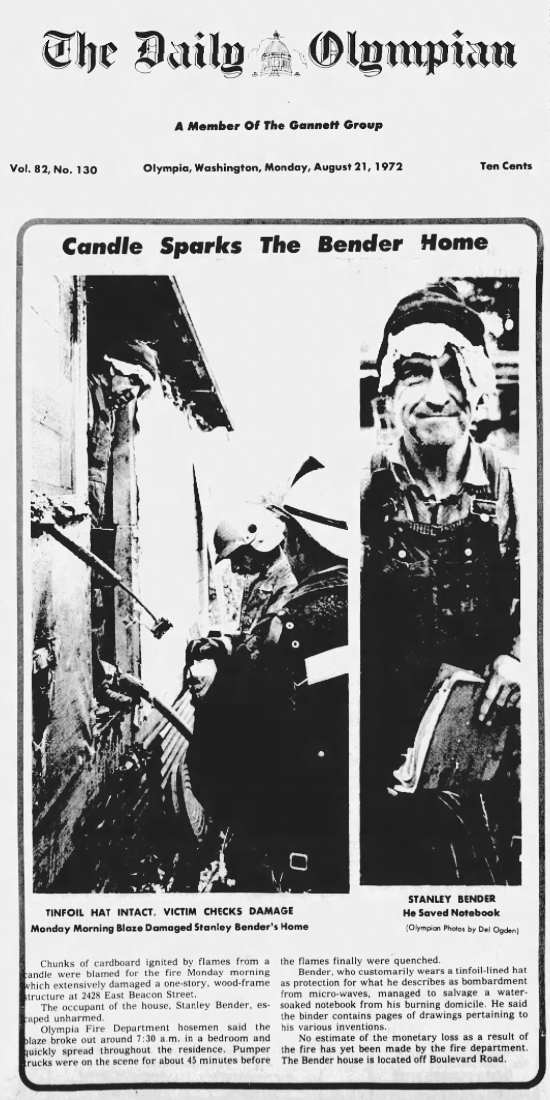
On August 21, 1972, when a candle fire extensively damaged his one-story wood-frame house at 2428 East Beacon Street in Olympia, Bender escaped unharmed. The first thing he salvaged from the burning house was a water-soaked notebook. The notebook contained pages of drawings pertaining to his various inventions. The newspaper photographed him examining the fire damage. One caption read: “TINFOIL HAT INTACT. VICTIM CHECKS DAMAGE.” The other: “STANLEY BENDER / He Saved Notebook.”
The newspaper thought the hat was the story. Bender thought the notebook was.
The Hat
The Daily Olympian reported that Bender “customarily wears a tinfoil-lined hat as protection for what he describes as bombardment from micro-waves.” The word “customarily” is significant. This was not an episode. It was a practice. Bender wore the hat every day. People in Olympia saw him on the streets for decades. They called him the Tinfoil Man.
He also wore foil on his shoulders. He applied a mixture of potassium permanganate to his face and hands as protection against what he called “the spray.” He wore rubber boots for years to protect his feet. When eating in public, he ate inside a large plastic bag to shield his food from contamination. He kept the car heater on high because he believed it helped counteract the effects.
A woman named Irina, who worked for Bender in her twenties, described driving him around Olympia: “We would drive to the health store, JayVee’s and I’d get him soup and he’d get into a giant plastic bag in the passenger seat of his car and eat the soup. One time a cop came over to us. It was a strange scene, 20 year old in the driver’s seat and a small man inside of a plastic bag next to me. The cop knew Stanley and left us alone.”
The cops knew Stanley. They left him alone. In a town where the police dispatcher in Cleveland told a woman to put on a tinfoil hat as a joke, the police in Olympia recognized the Tinfoil Man and let him be.
The Diary
After Bender died, a man named Shane found a portion of a handwritten diary among Bender’s belongings at a garage sale. He transcribed it and published it on a blog in 2006. The diary fragment is dated February 8, 1977, and runs eleven pages.
The document is a detailed, internally consistent account of what Bender believed was happening to him. He describes three categories of “Violation of Civil Liberties”: surveillance, “harassment by ray and spray,” and direct confrontation by trained operatives. He describes the rays as “microwave, electromagnetic radiation beams” aimed from aircraft, cars, and fixed ground positions. He describes chemical sprays applied to his body, his food, and his home, which he identifies as indole compounds, mercaptans, mustard gas, DMSO, and chlorinated hydrocarbons.
He describes the physical effects in technical language: “spasming of the blood vessels,” “thickens the blood,” “lowers cellular respiration rate,” “blood sugar and tri glycerides might rise from convulsion of adrenal pancreas and liver organs.” He describes countermeasures: rubber boots worn for three years until his feet recovered, hydrogen peroxide to remove spray, potassium permanganate mixture for exposed skin.
He describes an incident at the Viking Sauna Bath in the Franklin Hotel Building on East 4th Avenue, Olympia, where he says the Olympia police installed microwave surveillance through a hole in the ceiling. He describes the physical sensation when it was activated: “A blast of fire like a blowtorch hit me and I could smell an odor like hot paint. I could barely get my clothes back on, I was becoming paralyzed inside and out.” He called the police. The officer at the phone said, “It is a technical matter, we will move against it.” The microwaves diminished to a bearable level within two minutes.
He notes that before 1955, doctors gave him shock treatment at Sheppard Air Force Base.
TFRi presents the diary as a document, not as evidence of the events it describes. The diary does not prove that Bender was being subjected to microwave bombardment. It proves that Bender believed he was, that his belief was detailed and technically specific, that he had developed an elaborate system of countermeasures based on that belief, and that his account was internally consistent over a period of years.
Whether his experiences were symptoms of paranoid schizophrenia, as his diagnosis states, or responses to real stimuli that were classified as paranoid schizophrenia because the institutional framework had no other category for them, is a question this dispatch does not answer. The dispatch documents the man and the record he left. The question is for the reader.
The People Who Knew Him
The blog comments, the obituary, and the memorial record paint a portrait that is sharply different from what the phrase “tinfoil hat wearer” conjures in the cultural imagination.
MaryJo Blume, whose family adopted Bender: “Paranoid-Schizophrenic, Yes, Stanley Paul Bender was officially diagnosed with this medical ailment and took prescription meds for his condition. Stanley was Eccentric, YES, Scary? NO!!! Stanley Loved his fellow man and absolutely tried his darndest and wanted to help them by attempting to educate them regarding healthy foods, etc. He was a Gentle, Sharing, Caring, Kind and Loving GentlePerson and he suffered many trials and hardships attempting to remain true to his Belief System.”
Bryan: “I knew Stanley well. I have a cassette tape of him talking. He was a genius.”
Nathan, who drove Bender around Olympia: “Strangely pieces of his stories checked out when I did a little research.” Nathan investigated some of Bender’s claims about historical events and found them verifiable.
Reed W., who grew up in Olympia in the 1960s and 70s: “I have many memories of seeing ‘The Tinfoil Man.’ We would see him on the streets frequently. I remember him as being quiet and respectful. I never knew his name, or really had the opportunity to speak with him. I wish I had taken the time.”
The Delphi Schoolhouse community: after Bender died, his belongings from his trailer were sold at a fundraising rummage sale. The proceeds funded the ongoing maintenance and restoration of the Delphi Schoolhouse. “Without the huge amount of stuff we salvaged from his trailer we never would have raised as much funds as we did. His legacy lives on.”
Stanley Paul Bender. Quoted in his obituary, 2005.
The Parallels
In 1966, Leonard Kille, a patent-holding Polaroid engineer and Air Force veteran, had electrodes implanted in his brain at Harvard’s Massachusetts General Hospital. After the procedures destroyed his cognitive function, he was found in a VA hospital holding a metal wastebasket over his head. He said he was trying to stop the microwaves. He was diagnosed as delusional. A doctor ordered him aluminum foil to make a helmet. He died in institutional care in 1993, age 60.
In 1972, Stanley Bender, a self-proclaimed inventor and Army Air Corps veteran of two wars, was photographed on the front page of his local newspaper wearing a tinfoil-lined hat for the same stated reason: microwave bombardment. He was diagnosed with paranoid schizophrenia. He lived in Olympia for fifty years. He was known, recognized, and loved by his community. He died on Christmas Day, 2005, age 91.
Both were military veterans. Both were inventors or engineers. Both received electrical intervention on their brains (Kille: electrode implantation; Bender: shock treatment before 1955). Both reported microwave bombardment. Both put metal on their heads. Both were diagnosed with conditions that classified their experiences as pathology.
One was destroyed by the institutional response. The other survived it, for fifty years, by walking the streets of a small town wearing a tinfoil hat, carrying a notebook of inventions, and trying to educate people about healthy eating.
The difference between Kille and Bender is not their experience. Both described the same thing. The difference is what the institution did with them. Kille was inside the apparatus: hospitalized, experimented on, published, litigated, confined. Bender was outside it: diagnosed, medicated, and left alone. The institution destroyed Kille in the process of studying him. The institution ignored Bender in the process of dismissing him. One man lost everything. The other kept his hat, his notebook, and his community. The Tinfoil Man survived because nobody thought he was worth the trouble of a closer look. Whether that was mercy or neglect depends on what a closer look would have found.
Christmas Day, 2005
Stanley Paul Bender died on December 25, 2005, at Providence Saint Peter’s Hospital in Olympia, of complications from pneumonia. He was 91 years old. All eight of his siblings preceded him in death. His services were held on December 30 at Forest Funeral Home.
His adoptive family described him as “a Blessing/Treasure for all those who took the opportunity to personally become acquainted with him.” His belongings, salvaged from his trailer, funded a community restoration project. A man who had walked the streets of Olympia for half a century wearing tinfoil, carrying his inventions, educating strangers about nutrition, survived by being exactly what he was, in a town that let him be it.
He made tinfoil animals and sold them for a few dollars each. A man in Portland bought a tinfoil lion from him in 1993 and kept it on his bureau for years. “This Man was a Talented Mutha!” the man wrote. “I Miss the Tinfoil Man.”
Somewhere in Olympia, or in a landfill, or in someone’s attic, there may still be a water-soaked notebook of inventions that Stanley Bender saved from a burning house in 1972, the same year he became the first person photographed wearing a tinfoil hat on the front page of a newspaper. He saved the notebook. The newspaper ran the hat. Fifty-three years later, we know his name because of the hat. He would have wanted us to know about the notebook.
Sources
“Candle Sparks The Bender Home.” The Daily Olympian (Olympia, Washington), Monday, August 21, 1972. Vol. 82, No. 130. Front page. Photographs by Del Ogden.
Obituary for Stanley Paul Bender. Forest Funeral Home, Olympia, Washington. Services held December 30, 2005.
“The Tinfoil Man.” foilman.blogspot.com. Published November 19, 2006. Blog post by Shane, containing a transcription of a diary fragment (dated February 8, 1977) found among Bender’s belongings, and comments from people who knew him (MaryJo Blume, Bryan, Nathan, Irina G., Reed W., and others).
Tréguer, Pascal. Research on the historical usage of “tinfoil hat.” wordhistories.net.
Connected Research
This dispatch is part of the TINFOIL™ research series. Related dispatches:
They Put Electrodes in His Brain. He Put Metal on His Head. · The Year the Hat Became Real · The Gap Between the Fabric and the Head · The MIT Study · The Science
Stanley Bender wore his hat for fifty years. He also made tinfoil lions. TINFOIL™ exists because of people like him.