The Year the Hat Became Real
In 1854, a tinfoil cap was a party favor. In 1884, a tinfoil hat appeared in a New York humor magazine. In 1927, Julian Huxley described caps of metal foil that blocked a telepathic broadcast. In 1972, a man in Olympia, Washington was photographed wearing a tinfoil-lined hat to protect himself from microwave bombardment. His name was Stanley Bender. He is the earliest documented real person to wear a tinfoil hat for electromagnetic protection. The paranoia hat is younger than you think.
What People Think Happened
The standard account of the tinfoil hat goes something like this: it has been a symbol of paranoia “since the 1920s” or “since the early twentieth century.” It is vaguely associated with science fiction, with Cold War anxieties, with a generalized image of the unhinged person who believes the government is reading their thoughts. The origin is assumed to be old, the usage assumed to be continuous, the meaning assumed to be stable.
Almost none of this is correct.
The word history researcher Pascal Tréguer, working through American newspaper archives at wordhistories.net, has done the primary source work that most commentators skip. His research, combined with the Oxford English Dictionary’s citation record, reveals a timeline that is sharply different from the popular assumption. The protective tinfoil hat, the one worn to block signals, does not appear in the documented record until 1972. Not the 1920s. Not the 1950s. Nineteen seventy-two.
Everything before that is either a literal object or a work of fiction.
The Literal Hat: 1854-1920s
The Oxford English Dictionary’s earliest citation for “tinfoil cap” is from 1854. The source has not been fully identified in publicly available metadata, but based on the date and material culture of the period, it is almost certainly a literal object: a party cap, a costume piece, or a decorative item.
The earliest citation for “tinfoil hat” is from 1884, in Life, the New York City humor magazine founded in 1883 by John Ames Mitchell. The reference is political satire, not paranoia. Life described a Blaine-era Republican “Plumed Knights” parade: “A tinfoil hat, a spangled shirt, two feathers and a little kerosene, is the recipe.” The hat enters the English language as a symbol of cheap political pageantry: a makeshift costume for people marching in lockstep behind a candidate. The first tinfoil hat in American print is a joke about partisan conformity.
Tin foil was a ubiquitous household material throughout the Victorian and early twentieth-century period: used for wrapping food, lining cigar boxes, decorating Christmas trees, making children’s crafts. In 1897, The Farmers’ Advocate ran a lengthy feature on the tinfoil industry. In 1916, the Wise County Messenger noted “The Tinfoil hat is the newest development in military millinery.” In 1921, The Des Moines Register ran a children’s “Tinfoil Contest” where kids collected over fifty pounds of tinfoil for a hospital charity drive. The material was everywhere. The hat was nothing.
1907: The Carnegie Institute Recommends Tinfoil Hats
In August 1907, three major American newspapers published a syndicated feature based on Carnegie Institute research: “STUDYING THE EFFECT ON MANKIND OF SUMMER HEAT AND LIGHT RAYS.” The article included the subhead “Line Your Hat With Tinfoil” and an illustration captioned “THE HAT SHOULD BE LINED WITH TINFOIL.” Carnegie Institute scientists recommended tinfoil hat lining to reflect solar and heat radiation. The advice was genuine. The science was real. The recommendation was nationally distributed through the Evening Star (Washington, D.C.), The Kansas City Star, and The Cincinnati Enquirer.
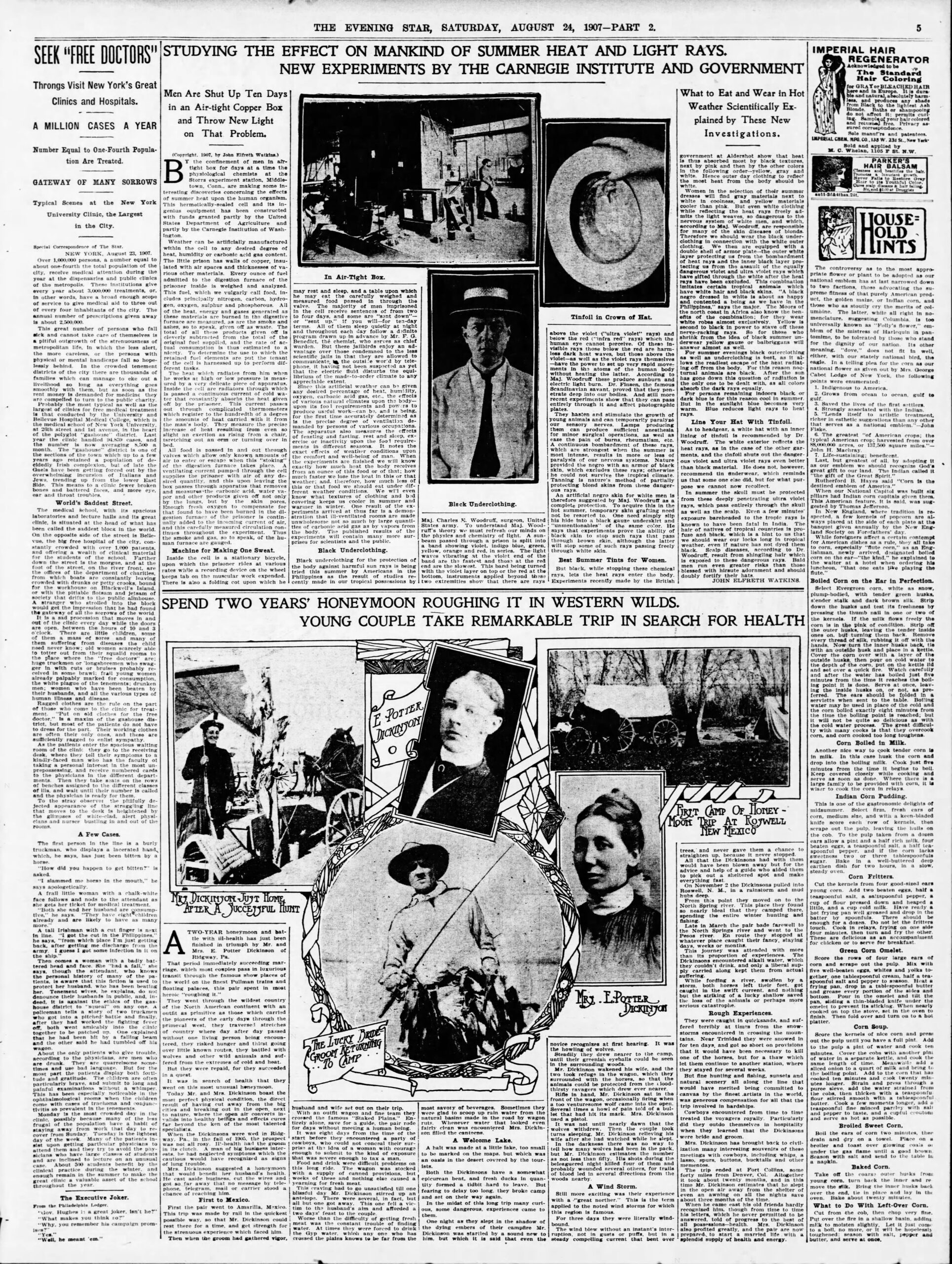
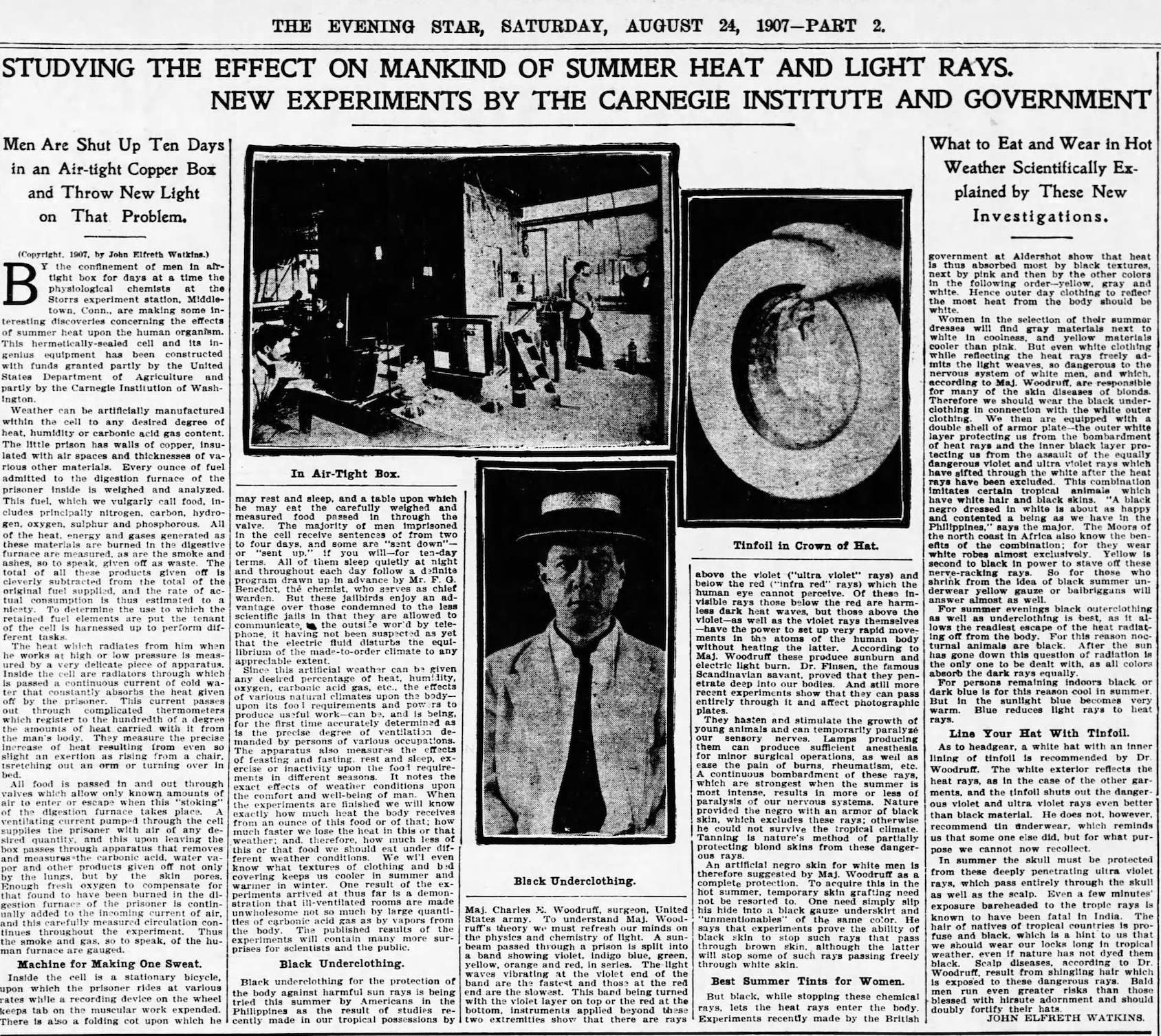
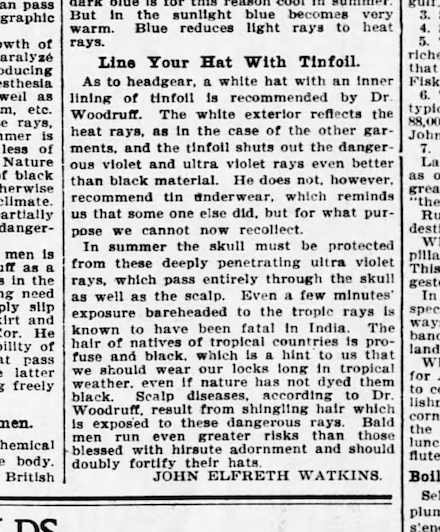

This is twenty years before Julian Huxley described caps of metal foil that block a telepathic broadcast. The Carnegie Institute was recommending, in mainstream American newspapers, that you line your hat with tinfoil to protect yourself from radiation. Not as a joke. Not as fiction. As science. This connection appears to be completely unknown in existing tinfoil hat scholarship.
The word “tinfoil hat” enters the English language in 1884 as political mockery: a cheap costume for partisan conformity. In 1907, it becomes a scientific recommendation: line your hat with tinfoil to reflect radiation. In 1927, it becomes a fictional countermeasure: caps of metal foil to block a telepathic broadcast. In 1972, it becomes a real-world practice: a man wearing tinfoil to stop microwaves. The word was available for nearly a century before the concept inhabited it. When the paranoia meaning finally arrived, it moved into a word that had already been coded as absurd (1884), scientifically legitimate (1907), and fictional (1927). All three prior meanings still operate beneath the surface. The joke, the science, and the fiction were all there before the practice. The practice inherited all of them.
The Fictional Hat: 1926-1927
In April 1926, Julian Huxley published “The Tissue-Culture King,” in which the narrator describes how the operators of a telepathic broadcast “grubbily” made “caps of metal foil” to shield themselves from the effects of their own apparatus. The metal foil “enormously reduced” (Yale Review) or reduced “to an infinitesimal amount” (Cornhill Magazine) the telepathic effect.
This is the earliest known description of metal headgear used as protection against a broadcast signal. It is fiction. It was published in a literary magazine edited by the author’s father, reprinted in an academic journal, and then republished in a pulp science fiction magazine by Hugo Gernsback in 1927. The concept crossed from literary fiction to academic publication to genre entertainment in fourteen months.
But between the fictional hat and the real hat, there is a gap of forty-six years. From 1927 to 1972, the documented record contains no instance of a real person wearing a tinfoil hat for electromagnetic protection. The concept existed in fiction. It did not yet exist in practice.
The Long Innocence: 1927-1971
For forty-five years after Huxley, every newspaper reference to a tinfoil hat in the TFRi primary source archive is literal. The hat remains an innocent object throughout the Depression, World War II, the early Cold War, the Space Race, and the counterculture era. The paranoia meaning simply does not exist in American newspaper print during this period.
1946: The Sanford Herald (North Carolina) reports on a children’s birthday party: “On arrival each guest was presented a colored tinfoil hat and varied colored balloons.” A party favor.
1949: The Cincinnati Enquirer describes New Year’s Eve revelers “wearing tinfoil hats.” A celebration.
1950: The Montgomery Advertiser’s “Rankin File” column: “wearing tinfoil hats and holding in martinis for olives.” New Year’s Eve again.
1960: A walking write-in political candidate in Redding, California: “Citizen Reed / Tinfoil hat folds sun.” The hat is a practical sun shield. Entirely functional.
1976: At a 4-H Fair in Anderson, Indiana, “king received a tin-foil hat” as a novelty contest prize.
This is the most significant finding in the archive. The “missing middle” where the Huxley concept existed only in the literary and science-fiction imagination, and had not yet entered vernacular American culture. For nearly half a century, the tinfoil hat was birthday parties, New Year’s Eve, and county fairs. Nobody was afraid of it. Nobody was mocking it. It was just a hat.
The Real Hat: August 21, 1972
On Monday, August 21, 1972, the front page of the Daily Olympian of Olympia, Washington carried the headline “Candle Sparks The Bender Home.” A fire ignited by a candle at 7:30 a.m. had extensively damaged a one-story wood-frame house at 2428 East Beacon Street. The occupant, Stanley Bender, escaped unharmed. One photo caption read: “TINFOIL HAT INTACT. VICTIM CHECKS DAMAGE.” The other: “STANLEY BENDER / He Saved Notebook.”
The article, with photographs by Del Ogden, reported that “Bender, who customarily wears a tinfoil-lined hat as protection for what he describes as bombardment from micro-waves, managed to salvage a water-soaked notebook from his burning domicile. He said the binder contains pages of drawings pertaining to his various inventions.”
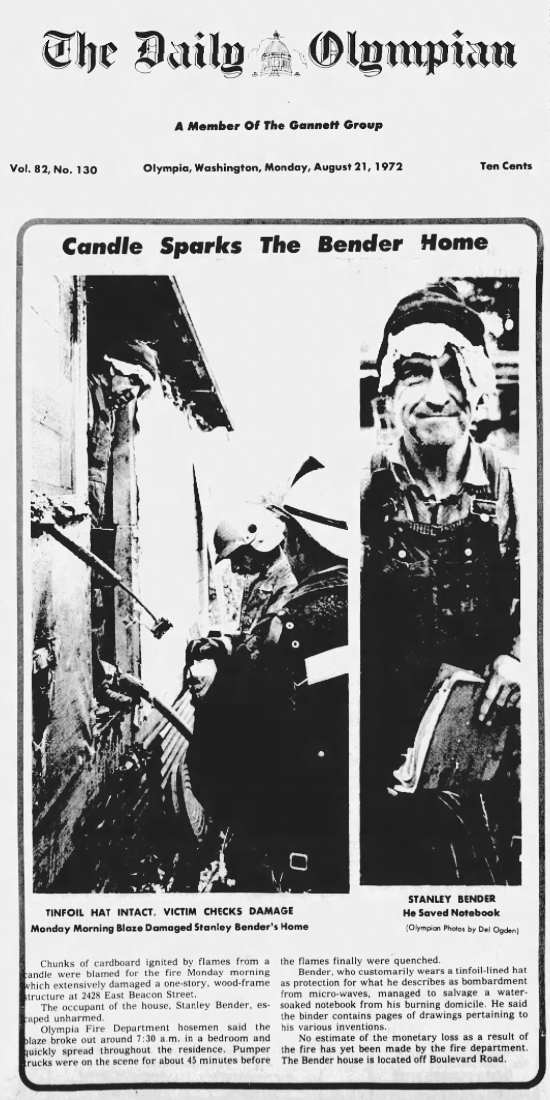
This is, as far as the documented record shows, the first real person photographed on the front page of a newspaper wearing a tinfoil hat for electromagnetic protection. Not a character in a story. Not a metaphor. Not a joke. A man in Washington State, wearing a tinfoil-lined hat because he believed microwaves were bombarding him. And he was an inventor. He saved a notebook of drawings of his inventions from the fire. The newspaper thought the hat was the story. Bender thought the notebook was.
Stanley Bender appears in no other context that TFRi has located. He is not a public figure. He is not connected to any known organization or movement. He is a man on the front page of a local newspaper, wearing a hat and saving his inventions from a fire.
1972. One year after Leonard Kille’s second brain surgery left him with grotesque facial movements and stiffened limbs. One year after Kille was found in a VA hospital holding a metal wastebasket over his head to stop the microwaves. One year before Peter Breggin published his investigation revealing that “Thomas R.” was a real person whose brain had been destroyed. There is no evidence that Stanley Bender in Olympia, Washington knew about Leonard Kille in Massachusetts. But in 1972, two men in two different states were doing the same thing for the same stated reason: putting metal on their heads because they believed microwaves were affecting their brains. One of them had electrodes in his brain. The other, as far as we know, did not. The year the hat became real was the year after the year the hat became necessary.
The Spread: 1977-1979
After Bender, the tinfoil hat appears in American newspapers with increasing frequency, in contexts that range from earnest to ironic.
1977: An article in the Daily Press of Newport News, Virginia about a UFO investigator casually references “tinfoil caps to ward off dangerous rays.” The tone is neither fully serious nor fully mocking. The hat has entered the journalistic vocabulary as a recognizable concept. (Tréguer, wordhistories.net)
1979, March: After the Three Mile Island nuclear accident, friends in Camp Hill, Pennsylvania planned a “Radiation Rock” party “where you dress up in tinfoil hats to keep out the gamma rays.” This is the earliest documented instance of the tinfoil hat as ironic social gesture: worn not because the wearer believes it works, but as a commentary on a real threat that has been officially minimized. The hat crosses from sincere protection to cultural performance. The party is the pivot point. (Tréguer, wordhistories.net)
1979, September: The Calgary Herald reported that a man wrote to the Mayor complaining that “a nasty neighbor’s deadly rays were bombarding his house and the tin foil cap on his head was not adequate protection.” The complaint is earnest. The man is wearing the hat and reporting that it is insufficient. He wants the Mayor to intervene. (Tréguer, wordhistories.net)
The Punchline: 1982-1983
1982: A Cleveland police dispatcher received a call from a woman complaining about a neighbor’s “invisible death ray.” The dispatcher told her to wear a tin foil hat. She called back weeks later asking whether “you put the shiny side out or in.” A patrol car subsequently observed her “working in her yard with an aluminium hat on.” (Tréguer, wordhistories.net)
This anecdote contains the entire trajectory of the tinfoil hat in a single exchange. A woman reports a threat. An authority dismisses her with a joke. She takes the joke seriously. She implements the solution. She calls back with a technical question about the solution. The authority confirms, by patrol car observation, that she is wearing the hat. At no point does anyone investigate the complaint. The hat has replaced the investigation. The punchline has become the policy.
1983: A review of the film Lovesick described “a derelict turned out into the street, wearing a tin-foil hat to keep the Trade-Center beams off his brain.” The hat is now a cinematic shorthand for mental illness. It has completed its journey from party hat (1854) to fictional shield (1927) to sincere protection (1972) to ironic gesture (1979) to cultural cliché (1983). The entire arc took 129 years. The paranoia phase took eleven. (Tréguer, wordhistories.net)
Cleveland police dispatcher anecdote, 1982. Reported by Pascal Tréguer, wordhistories.net.
The Timeline
1854: “Tinfoil cap” in print. A literal object.
1884: “Tinfoil hat” in Life magazine. Political satire. A cheap costume for partisan conformity.
1892: Palfrey tests an “insulative electrical contrivance encircling the head.” Reports failure. Not called a tinfoil hat.
1907: Carnegie Institute recommends lining hats with tinfoil to reflect solar radiation. Nationally syndicated. Genuine science.
1926: Huxley describes “caps of metal foil” that block a telepathic broadcast. Fiction.
1927: Gernsback reprints the story in Amazing Stories. The concept enters science fiction.
1927-1971: The Long Innocence. Every newspaper reference is literal: party hats, New Year’s Eve, birthday favors, sun shields, county fairs. Zero paranoia usage for 45 years.
1966-1971: Leonard Kille has electrodes implanted in his brain. Is found with a metal wastebasket over his head. A doctor orders him aluminum foil.
1972 (August 21): Stanley Bender, Olympia, Washington. Front page of the Daily Olympian. First documented real person photographed wearing a tinfoil hat for electromagnetic protection. “TINFOIL HAT INTACT.”
1977: “Tinfoil caps to ward off dangerous rays” in a Virginia newspaper. The concept is now journalistic shorthand.
1979 (March): Three Mile Island “Radiation Rock” party. The hat becomes an ironic social gesture.
1979 (September): Calgary man complains to the Mayor that his tinfoil cap is insufficient protection.
1982: Cleveland dispatcher tells a woman to wear a tinfoil hat. She asks about the shiny side.
1983: Lovesick film review. The hat is cinematic shorthand for mental illness.
1992: “Tinfoil hat” enters internet culture as mockery.
2005: MIT tests aluminum foil helmets. Finds amplification at government-allocated frequencies. Filed under comedy.
What the Timeline Shows
The protective tinfoil hat, the one people mean when they use the phrase as an insult, has existed for approximately fifty years. Not a century. Not since the 1920s. Since 1972. The word is 170 years old. The concept is 100 years old. The practice is 50 years old. The mockery is 40 years old. At no point in this timeline does the mockery follow an investigation. The hat was dismissed before it was tested. The test, when it finally came in 2005, produced results that nobody has adequately addressed.
The arc from party hat to paranoia symbol took 129 years. The arc from first real-world use to universal punchline took eleven. The speed of the dismissal is itself a data point. A concept that took a century to emerge from fiction into practice was converted into a joke in just over a decade. Whatever mechanism accomplishes that conversion, it operates faster than the science that would be needed to evaluate the claim.
The woman in Cleveland asked the right question. If you are going to put a conductive material on your head, orientation matters. The shiny side of aluminum foil is slightly more reflective than the matte side due to the manufacturing process (two sheets are rolled together; the side that contacts the roller is polished, the other is not). The difference in conductivity is negligible. But the question itself, “shiny side out or in,” is an engineering question. It is a question about the interface between a conductive surface and an electromagnetic field. It is the same category of question that the commercial EMF hat industry does not answer about its own products. A woman calling a police dispatcher in 1982 asked a more specific technical question about conductive headgear than any manufacturer currently includes in its product documentation.
Sources
TFRi Primary Source Archive: “The Tinfoil Hat in American Print, 1854-2000.” 51 citations from American newspapers and periodicals. Original page scans sourced through Newspapers.com, HathiTrust, and the Oxford English Dictionary.
Tréguer, Pascal. Research on the historical usage of “tinfoil hat” and related terms. wordhistories.net, 2023.
Oxford English Dictionary. Entries for “tinfoil cap” (1854) and “tinfoil hat” (1884, in Life, Vol. IV, No. 92, Oct. 2, 1884). Last updated September 2025.
Life magazine (New York, NY), Vol. IV, No. 92, October 2, 1884. Satirical description of a Blaine/Republican “Plumed Knights” parade. HathiTrust Digital Library, Cornell University scan.
“STUDYING THE EFFECT ON MANKIND OF SUMMER HEAT AND LIGHT RAYS.” Evening Star (Washington, D.C.), August 24, 1907. Also The Kansas City Star and The Cincinnati Enquirer, August 25, 1907. Carnegie Institute recommendation.
“Candle Sparks The Bender Home.” The Daily Olympian (Olympia, Washington), Vol. 82, No. 130, August 21, 1972. Front page. Photographs by Del Ogden.
“Radiation Rock” party report. The Tampa Times, March 31, 1979.
“Nasty neighbor’s deadly rays.” The Calgary Herald, September 13, 1979.
Cleveland police dispatcher anecdote. 1982. Reported by Pascal Tréguer, wordhistories.net.
Lovesick (1983) film review. York Daily Record (York, PA), March 16, 1983.
Connected Research
This dispatch is part of the TINFOIL™ research series. Related dispatches:
They Put Electrodes in His Brain · The Man Who Tested It First · The Tissue-Culture King · The Man Who Filed It Under Fiction · The Gap Between the Fabric and the Head · The MIT Study · The Science
The hat was a party favor for seventy years. A fictional shield for forty-six. A real countermeasure for eleven before it became a punchline. TINFOIL™ sells the question that the punchline was designed to close.