The Label
In 1863, a New York Times letter used the phrase “conspiracy theory” to dismiss a political claim. In 1964, a Columbia historian reframed conspiracy thinking as a psychological disorder. In 1967, the CIA sent a dispatch to its media contacts recommending the phrase as a tool for discrediting critics. In 2009, a Harvard law professor proposed that the government infiltrate groups that believe conspiracy theories. None of these people were working together. They did not need to be.
The Word Before the Weapon
The phrase “conspiracy theory” was not invented by the CIA. This is itself a conspiracy theory, and it is false.
The Oxford English Dictionary traces the earliest known usage to January 11, 1863. Charles Astor Bristed, an American author and grandson of John Jacob Astor, used it in a letter to the editor of The New York Times. He was dismissing claims that British aristocrats were conspiring to weaken the United States during the Civil War. The American public, Bristed wrote, lacked understanding of European political complexities. Their suspicions were “most readily accounted for on the conspiracy theory.”
His usage is instructive. Bristed did not define the phrase or place it in quotation marks. He used it casually, as though his readers would recognize it, which suggests the term was already in circulation before the earliest surviving record. Even at this first documented sighting, “conspiracy theory” was not a neutral label. Bristed did not argue that British aristocrats were not hostile to American interests. He argued that believing in a coordinated plan was the product of minds too unsophisticated to grasp how complex the world really is. People who saw conspiracies, in his framing, were people who could not handle ambiguity.
Hold that thought. It will reverse itself before this dispatch is over.
By the 1870s and 1880s, the phrase appeared regularly in American newspapers, often in connection with courtroom proceedings. After the assassination of President James Garfield in 1881, “The Conspiracy Theory” appeared in headlines as a label for the hypothesis that the assassin did not act alone. After the assassination of President William McKinley in 1901, it appeared again. In each case, the phrase was applied to the claim that required more actors, more coordination, and more secrecy than the official account found necessary.
The word existed for a century before the CIA took notice of it. But it existed mostly as a neutral descriptor, a hypothesis type. What happened next was not invention. It was weaponization.
The Historian
In November 1964, Harper’s Magazine published an essay by Richard Hofstadter, DeWitt Clinton Professor of American History at Columbia University. The essay was titled “The Paranoid Style in American Politics.” It had been adapted from the Herbert Spencer Lecture Hofstadter delivered at Oxford University on November 21, 1963, one day before the assassination of President Kennedy.
Hofstadter’s thesis was not subtle. He argued that a recurring strain of American political thought was characterized by “heated exaggeration, suspiciousness, and conspiratorial fantasy.” He called it the paranoid style, and he acknowledged borrowing a clinical term for political purposes. He also acknowledged that the term was pejorative, and that he meant it to be.
The essay traced what Hofstadter saw as a persistent pattern from the anti-Masonic movement of the 1820s through McCarthyism. His immediate target was the Goldwater movement and the conservative grassroots that had seized the Republican nomination. The essay was not about conspiracies. It was about the kind of people who believe in them.
This is the move that matters. Hofstadter did not engage with whether specific conspiracy claims were true or false. He reframed the question. Conspiracy thinking, in his account, was not an epistemological category, a type of claim about what happened. It was a psychological category, a type of mind that makes such claims. The question was no longer “is this claim accurate?” The question was “what kind of person believes this?”
The answer, in Hofstadter’s framework, was: a paranoid one.
Richard Hofstadter, “The Paranoid Style in American Politics,” Harper’s Magazine, November 1964
Hofstadter’s essay performed a transformation that the academic literature is still unpacking six decades later. Before 1964, a conspiracy theory was a theory about a conspiracy. After Hofstadter, a conspiracy theory was a symptom. The question of evidence became secondary to the question of temperament. This shift from epistemology (what do we know?) to psychology (what is wrong with you?) is the foundational move that enables the conspiracy theory label to function as a dismissal rather than a description. Hofstadter himself noted that “nothing really prevents a sound program or demand from being advocated in the paranoid style.” He acknowledged, in other words, that the style could contain truth. But the essay’s influence flowed in one direction: toward diagnosis, not investigation.
The Dispatch
On April 1, 1967, the CIA’s Chief of Clandestine Services sent a dispatch to CIA stations and bases worldwide. The document was titled “Countering Criticism of the Warren Report.” Its official designation was CIA Document 1035-960. Its classification was Secret.
The document was released to The New York Times in 1976 through a Freedom of Information Act request. It is held in the U.S. National Archives as Record Number 104-10406-10110, part of the Russ Holmes Work File in the Records of the Central Intelligence Agency. Its text is publicly available. Its existence is not disputed.
The dispatch stated that growing skepticism toward the Warren Commission’s findings was “a matter of concern to the U.S. government, including our organization.” It noted that the CIA had contributed information to the investigation, and that conspiracy theories “have frequently thrown suspicion on our organization.”
The stated aim of the dispatch was to provide material for countering and discrediting critics, and to inhibit the circulation of their claims in other countries. It recommended specific tactics: employ propaganda assets to refute critics through book reviews and feature articles. Accuse critics of being politically motivated. Accuse them of financial interests. Accuse them of being infatuated with their own theories. Point out that large-scale conspiracy would be impossible to conceal. Claim that no significant new evidence has emerged.
The dispatch did not invent the term “conspiracy theory.” It used it. It used it as a tool, in an internal document marked Secret, in a directive to intelligence assets embedded in the media, with the explicit goal of managing public perception.
The CIA did not create the label. It requisitioned it.
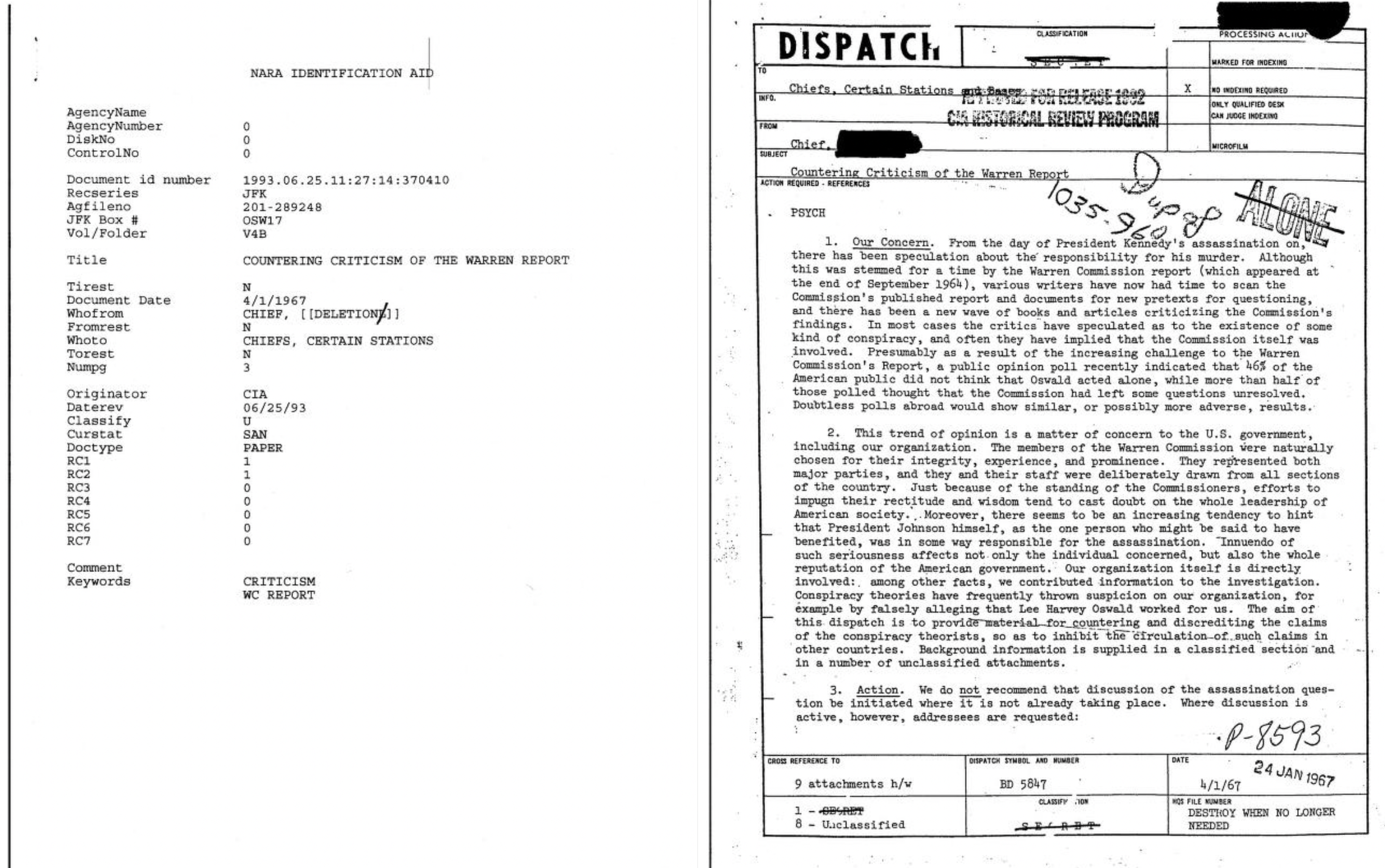
CIA Document 1035-960 is frequently cited by people who overstate its significance and frequently dismissed by people who understate it. It did not invent the term “conspiracy theory.” The term was over a century old. It did not create a vast media manipulation program from scratch. But it is a primary-source document in which an intelligence agency explicitly instructs its personnel to use media assets to deploy a specific rhetorical strategy for discrediting critics of a government investigation. The document exists. It says what it says. The interpretation is debated. The text is not.
The Philosopher
The academic study of conspiracy theories as an epistemological subject began, in an ironic sense, with the philosopher who was least interested in whether any particular conspiracy theory might be true.
Karl Popper addressed what he called “the conspiracy theory of society” in The Open Society and Its Enemies, first published in 1945. His target was not individual conspiracy theories. It was a worldview: the belief that all social phenomena can be explained by discovering the people who planned and conspired to bring them about. Popper argued that this view was wrong because it overestimates human intentionality and underestimates unintended consequences. The main task of social sciences, he wrote, was to analyze the unintended social repercussions of intentional human actions.
Popper’s argument was sound against its actual target. Nobody serious maintains that every social phenomenon is the product of a conspiracy. But as philosopher Charles Pigden of the University of Otago pointed out in his 1995 paper “Popper Revisited, or What Is Wrong With Conspiracy Theories?”, the falsity of the grand conspiracy theory of society is perfectly compatible with the existence of many actual conspiracies. Popper showed that it is silly to suppose that everything is a conspiracy. He did not show that it is silly to suppose that anything is.
Pigden’s paper, published in Philosophy of the Social Sciences, was the first philosophical challenge to the assumption that conspiracy theories are inherently irrational. The argument was deductive and, by philosophical standards, devastating: if you adopt the policy of systematically doubting conspiracy theories, you end up concluding that history is bunk and the nightly news unbelievable. Watergate was a conspiracy. Iran-Contra was a conspiracy. The plotting required to win World War II was a conspiracy. To admire Churchill is to admire a successful conspirator.
Four years later, in 1999, Brian Keeley of Pitzer College published “Of Conspiracy Theories” in The Journal of Philosophy. Keeley’s paper is the foundational work of analytical philosophy on the subject. He defined a conspiracy theory as an explanation of a historical event in terms of the significant causal agency of a relatively small group of persons acting in secret. He tried to distinguish warranted conspiracy theories (such as those explaining Watergate) from unwarranted ones. His conclusion was that the task was harder than expected: there is no a priori method for making the distinction.
This is the key finding. The most rigorous analytical attempt to define what makes a conspiracy theory unwarranted concluded that you cannot do it in advance. You have to look at the evidence.
The Spectrum
The philosophical literature that followed Keeley’s paper maps a spectrum of positions on conspiracy theories. The positions are precise and their disagreements are instructive.
David Coady, Senior Lecturer in Philosophy at the University of Tasmania, edited Conspiracy Theories: The Philosophical Debate (Ashgate, 2006), the first major anthology on the subject. Coady’s position is that on the best definitions of what it is to be a conspiracy theorist, conspiracy theorists do not deserve their reputation for irrationality. He argues that the truly worrying form of irrationality is not at the conspiracy theorist end of the spectrum, but at the other end: the reflexive dismissal of any claim labeled “conspiracy theory” without examination of its evidence.
Lee Basham has written extensively on the epistemology of conspiracy theories and advocates what he calls “studied agnosticism”: neither automatic belief nor automatic dismissal, but examination of evidence case by case.
Pigden, in his later work, developed a deductive argument from premises he considers undeniable: that conspiracies happen, that some succeed, and that the only way to identify them is to investigate them. His conclusion is that if you are not a conspiracy theorist in what he calls the “anodyne sense of the word,” you are an idiot in the Greek sense, a person who takes no interest in public affairs.
On the other side, Steve Clarke argues that conspiracy theories tend to overestimate dispositional explanations for events, and that a degree of skepticism toward them is warranted. And Quassim Cassam has argued that conspiracy theorists exhibit genuine epistemic vices.
The debate is live. It is rigorous. It is conducted in peer-reviewed journals by professional philosophers. And it has produced no consensus that conspiracy theories, as a category, can be rationally dismissed.
In 1863, Bristed framed conspiracy theorists as minds too simple to handle complexity. They saw coordinated plots because they could not grasp ambiguity. In the 21st century, the philosophical literature inverts this completely. Coady argues that the truly irrational position is at the opposite end of the spectrum: the reflexive need to collapse every claim into “credible” or “conspiracy theory” without examining evidence. Basham’s “studied agnosticism” requires holding uncertainty open. Pigden’s framework demands that citizens investigate rather than dismiss. The people Bristed looked down on for being too simple to tolerate ambiguity are now, by the academic standard, the ones doing the harder epistemic work. The label has not merely shifted. It has reversed polarity. The inability to handle ambiguity now belongs to the people who use the label, not the people it is applied to.
The Proposal
In 2009, two Harvard Law School professors published a paper titled “Conspiracy Theories: Causes and Cures” in the Journal of Political Philosophy. A working paper version had circulated since January 2008. The authors were Cass Sunstein and Adrian Vermeule.
Sunstein was not an obscure academic. He was one of the most cited legal scholars in the United States. In 2009, President Obama appointed him Administrator of the White House Office of Information and Regulatory Affairs, the office responsible for reviewing federal regulations. He served from 2009 to 2012.
The paper described people who hold conspiracy theories as suffering from a “crippled epistemology,” meaning they have access to a limited and skewed set of information. The proposed remedy was what Sunstein and Vermeule called “cognitive infiltration”: government agents or their allies should enter conspiracy theory groups, either in person or online, either openly or anonymously, to introduce “cognitive diversity” by planting doubts about the group’s beliefs.
To state this plainly: a future White House official proposed, in a peer-reviewed journal, a plan in which government agents would covertly enter groups of citizens and manipulate their beliefs. A secret coordinated action by a small group of powerful people to influence public perception. By Keeley’s own definition, the proposal is itself a conspiracy theory. The difference is that this one was published in the Journal of Political Philosophy and its author was confirmed by the United States Senate.
The paper did not distinguish between conspiracy theories that are true and those that are false. It treated them as a uniform category requiring management. Philosopher David Coady, in a detailed critique, pointed out that their assertion that conspiracy theories in “open societies” are usually unjustified conflicts with documented cases such as Watergate and MKUltra, conspiracies that were real, were in open societies, and persisted for years.
The Sunstein paper is the logical terminus of the Hofstadter move. Once conspiracy thinking is reclassified as a pathology rather than a type of claim, it becomes something to treat rather than something to evaluate. And the prescription, in a paper published in a journal and written by a man who would shortly be appointed to a senior White House position, was infiltration.
Sunstein and Vermeule, “Conspiracy Theories: Causes and Cures,” Journal of Political Philosophy, 2009
Consider the full recursion. A government official proposes that government agents covertly infiltrate groups of people who believe that the government acts covertly. If members of those groups later suspect they are being infiltrated, that suspicion would itself be classified as a conspiracy theory, evidence of the very “crippled epistemology” that justified the infiltration. The proposal does not merely respond to conspiracy theories. It manufactures the conditions for new ones, then pre-labels the response to its own existence as irrational. The academic term for this is “self-sealing.” Sunstein and Vermeule used that exact term to describe conspiracy theories. They did not appear to notice that their proposal shared the property.
The Structure
Here is what the documented record shows. Not what it implies. What it shows.
The term “conspiracy theory” existed as a neutral descriptor in English since at least 1863. It was used in newspapers, courtrooms, and political commentary to describe a hypothesis involving coordinated secret action.
In 1964, Hofstadter reframed conspiracy thinking as a psychological phenomenon rather than an epistemological one. The question shifted from “is this claim true?” to “what kind of mind produces this claim?”
In 1967, the CIA circulated an internal dispatch recommending that its media assets deploy the conspiracy theory label to discredit critics of the Warren Commission. The dispatch was classified Secret. It was released via FOIA in 1976.
In 1995, 1999, and the years following, professional philosophers began examining the term analytically and concluded that there is no a priori basis for dismissing conspiracy theories as a category. The most rigorous academic work on the subject finds that the label functions as a social tool for exclusion, not as an epistemological tool for evaluation.
In 2009, a Harvard professor proposed government infiltration of groups that hold conspiracy theories. He was appointed to a senior White House position the same year.
These are separate events. They were not coordinated. Nobody sat in a room and designed this sequence. That is what makes it interesting. A label that began as a neutral term was converted, through independent actions by a historian, an intelligence agency, and a legal scholar, into a mechanism that suppresses inquiry by reclassifying it as pathology.
No conspiracy was required. The system built itself.
The Question Nobody Asks
The conspiracy theory label is applied categorically. If a claim is labeled a conspiracy theory, it is treated as dismissed. But there is a question embedded in this practice that almost nobody asks, and certainly nobody tracks.
What is the accuracy rate?
Of all the claims that have been labeled “conspiracy theory” by mainstream institutions over the past 60 years, how many turned out to be substantiated by subsequent evidence? Is it 1 percent? 10 percent? 30 percent? Is there a study? Has anyone counted?
The answer, as of this writing, is no. No meta-analysis exists. No systematic review has been conducted. The label is applied with the confidence of a diagnostic instrument, but nobody has tested the instrument.
A diagnostic label that has never been calibrated against outcomes is not a diagnostic label. It is a ritual.
The academic literature on conspiracy theories is vast and growing. It spans philosophy, psychology, political science, and sociology. Studies examine why people believe conspiracy theories, what psychological traits correlate with belief, how conspiracy beliefs spread through social networks, and how they might be countered. What the literature does not contain, with vanishingly rare exceptions, is any systematic study of how often claims labeled “conspiracy theory” turn out to be accurate. The field treats conspiracy thinking as a phenomenon to be explained rather than a set of claims to be evaluated. This is the Hofstadter framework operating at the disciplinary level: the diagnosis replaced the investigation so thoroughly that the discipline forgot to check whether the patients were right.
The Definition
Is “conspiracy theory” an epistemological category or a social one?
If it is an epistemological category, a type of claim about the world, then it should be evaluated like any other claim: by evidence. Some conspiracy theories are true (Watergate, MKUltra, COINTELPRO, the Tuskegee syphilis experiment, the Gulf of Tonkin fabrication, NSA mass surveillance). Some are false. Some remain undetermined. The label itself tells you nothing about accuracy. You have to look at each case.
If it is a social category, a label applied to claims the consensus wants to exclude, then it functions as a boundary marker. It does not evaluate evidence. It manages who gets to participate in the conversation. The word “conspiracy” describes the content of the claim. The word “theory” describes its epistemic status. But the compound phrase “conspiracy theory,” as deployed in public discourse, describes neither. It describes the social position of the person making the claim: outside the boundary of acceptable thought.
The academic literature suggests the term functions as both, but is deployed almost exclusively as the latter. It is, in the language of philosophy, a “Tonkish term”: a word that carries inferential baggage far beyond its literal meaning. When you hear “conspiracy theory,” you are not receiving information about the claim. You are receiving instructions about how to regard the person who made it.
This dispatch defines the term for the purposes of this series. A conspiracy theory is a claim that a significant event was caused in whole or in part by the secret coordinated action of a small group. Some such claims are true. Some are false. The label is not a verdict. It is a description. Whether the described claim is accurate is a separate question, answerable only by evidence.
The rest of this series will examine what happens when the label is treated as the verdict.
This dispatch cites 13 sources across four categories. Estimated breakdown: primary documents (CIA Document 1035-960 via FOIA and National Archives, Bristed letter via New York Times archive, White House confirmation record) ~25%; academic and scholarly (Keeley, Pigden, Coady, Popper, Sunstein and Vermeule, Basham, McKenzie-McHarg, Internet Encyclopedia of Philosophy) ~55%; independent journalism (Hofstadter’s Harper’s Magazine essay, which functions as both journalism and scholarship) ~10%; subject’s own statements (Hofstadter’s and Sunstein’s published arguments, cited as primary exhibits of the positions this dispatch examines) ~10%.
These percentages are editorial estimates, not computed metrics. A source may appear in more than one category. A dispatch about how a label was constructed across institutions will necessarily lean toward the academic literature that dissected it and the primary documents that evidence it. The relevant question is whether independent sources corroborate the factual claims. In this dispatch, all factual claims are independently verifiable through at least one non-subject source. The full source list follows.
Sources
Charles Astor Bristed, letter to the editor, The New York Times, January 11, 1863. First known usage of “conspiracy theory” per Oxford English Dictionary.
Richard Hofstadter, “The Paranoid Style in American Politics,” Harper’s Magazine, November 1964. Adapted from the Herbert Spencer Lecture, Oxford University, November 21, 1963.
CIA Document 1035-960, “Countering Criticism of the Warren Report,” April 1, 1967. U.S. National Archives, Record Number 104-10406-10110, Records of the Central Intelligence Agency. Released via FOIA, 1976.
Karl Popper, The Open Society and Its Enemies (London: Routledge, 1945), Vol. 2, Ch. 14.
Charles Pigden, “Popper Revisited, or What Is Wrong With Conspiracy Theories?”, Philosophy of the Social Sciences, Vol. 25, No. 1, 1995, pp. 3-34.
Brian L. Keeley, “Of Conspiracy Theories,” The Journal of Philosophy, Vol. 96, No. 3, March 1999, pp. 109-126.
David Coady, ed., Conspiracy Theories: The Philosophical Debate (Aldershot: Ashgate, 2006).
David Coady, “Cass Sunstein and Adrian Vermeule on Conspiracy Theories,” Argumenta, 2017.
Charles Pigden, “Conspiracy Theories and the Conventional Wisdom Revisited,” in Secrets and Conspiracies, ed. Olli Loukola (Brill, 2022).
Cass R. Sunstein and Adrian Vermeule, “Conspiracy Theories: Causes and Cures,” Journal of Political Philosophy, Vol. 17, No. 2, 2009, pp. 202-227. Working paper version: Harvard Public Law Working Paper No. 08-03, January 2008.
Andrew McKenzie-McHarg, “Conspiracy Theory: The Nineteenth-Century Prehistory of a Twentieth-Century Concept,” in Conspiracy Theories and the People Who Believe Them, ed. Joseph E. Uscinski (Oxford University Press, 2018).
Internet Encyclopedia of Philosophy, “Conspiracy Theories,” s.v. philosophical literature survey.
White House Office of Management and Budget, confirmation of Cass R. Sunstein as OIRA Administrator, September 10, 2009.
Connected Research
This dispatch is the first in the TINFOIL™ Consensus Machine series, an eight-part investigation into how institutional knowledge systems manage what counts as credible. Related dispatches:
The Oldest Trick in the Book · The List · The Percentage · The Reliable Source · The Co-Founder · The Entry · The Revision · The Giggle Factor · They Put Electrodes in His Brain · The Science
TINFOIL™ makes cognitive defense gear for people who read primary sources.